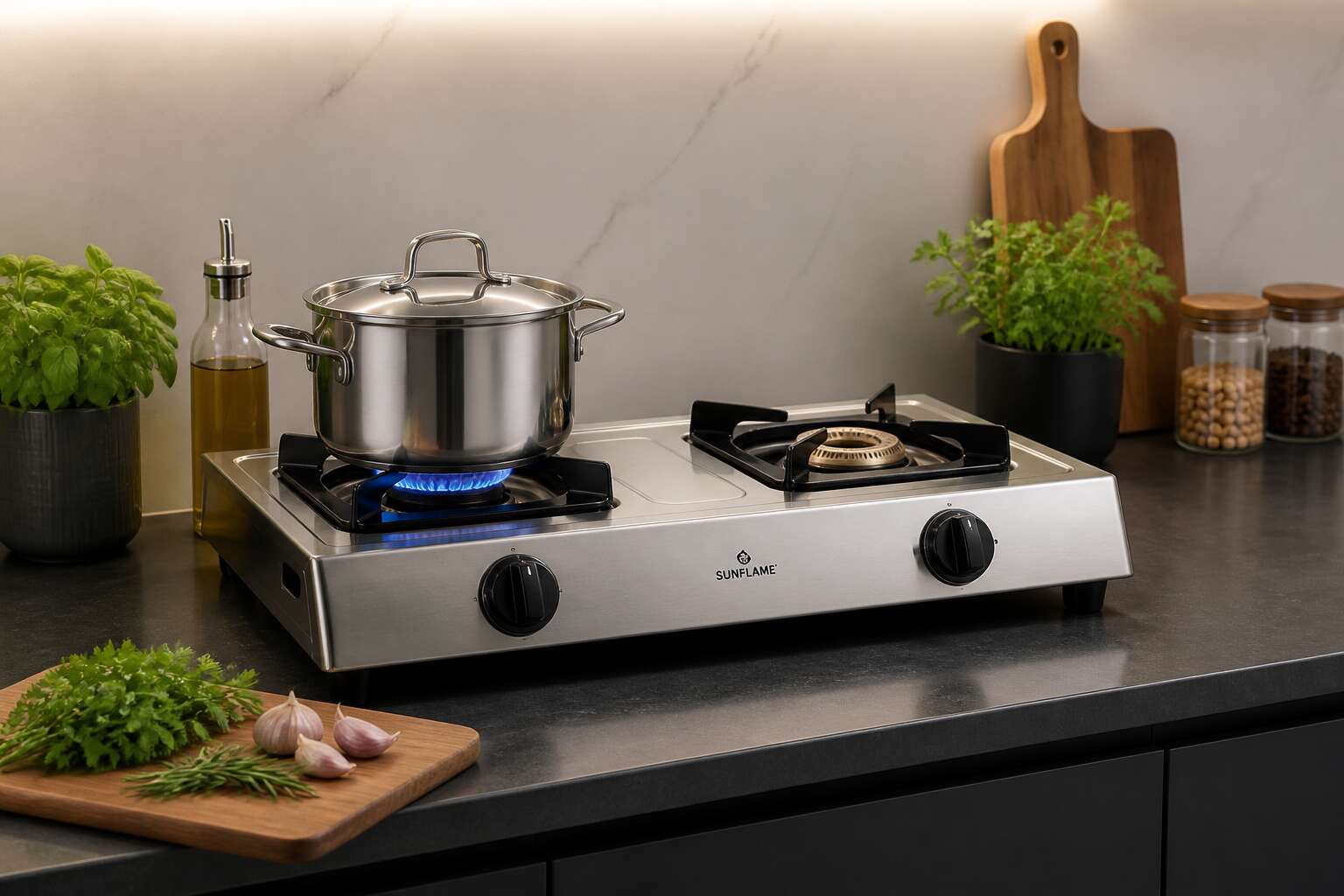
Key Factors to Consider When Choosing a Two-Burner Gas Stove
Burner Power and BTU Output
A gas stove 2 burner stainless steel unit might look identical from the outside, but the real difference hides in the BTU output. For a two burner stove, you need one high output burner for rapid boiling and one low output burner for gentle simmering. Most residential burners range from 5,000 to 15,000 BTUs, so check the specs before you buy.
The honest test is how evenly the heat distributes across your pan. A burner with high BTUs but poor distribution will scorch the edges while leaving the center cold. Also consider the type of cooking you do. For everyday meals, a total output around 20,000 BTUs across both burners works fine.
Here is what to inspect on any gas stove 2 burner stainless steel model:
– The simmer burner’s minimum output, because low heat control matters for sauces.
– The maximum output for the power burner, especially if you use a wok.
– The burner cap material, since stainless steel rings look neat but affect heat retention.
A stainless steel body does not change the flame performance, but it makes cleaning easier after spills. That is a bonus, not the main factor. Match the BTU output to your cookware thickness to avoid hot spots.
Build Quality and Material Durability
The average gas stove 2 burner stainless steel model endures over 10,000 ignitions across its lifespan, so build quality matters as much as the flame. The stainless gauge, usually 0.8 to 1.0 millimetres, determines whether the body dents or bows after years of heat cycling. Cheaper units use thinner sheets that warp, causing the surface to rock under heavy pots.
Inspect the seam welds. Continuous welds survive thermal stress; spot welds crack. Check the control knobs too. Zinc alloy knobs with metal stems handle daily twisting without stripping, and brass valve stems resist corrosion from gas and moisture.
Key durability markers:
- Porcelain enamel drip trays, since raw steel rusts.
- Reinforced grate arms that lock into the chassis.
- A brushed stainless steel back panel that hides scratches.
You will pay more for these details, but a solidly welded gas stove 2 burner stainless steel unit can outlast its warranty by a decade.
Safety Features for Peace of Mind
Most home cooks fixate on flame size or cleaning ease, yet the real story unfolds when you consider what happens in the split second after a boil over or a sudden gust near an open window. A two burner gas stove stainless steel unit with robust safety architecture transforms a mundane appliance into a quiet guardian of the household.
The flame failure device, often called a thermocouple, is the hero here. It constantly monitors the pilot flame and shuts off the gas supply within seconds if the fire dies unexpectedly. This is not a luxury feature. In South Africa, where paraffin and gas incidents remain a concern, this mechanism prevents gas from leaking silently into your kitchen while you are distracted.
Consider also the physical barriers. A well designed cooktop includes a sealed burner base, which stops food debris and liquids from seeping into the internal gas lines. This design choice reduces the risk of clogged jets and uneven flames, but more importantly, it prevents the accumulation of flammable residue.
– Reinforced pan supports with rubber feet to prevent sliding and tipping.
– A three position stop valve that prevents turning the knob past the maximum flame point.
– Cool touch knobs that remain safe to handle even after an hour of simmering.
These safety elements work in concert. The best gas stove 2 burner stainless steel models on the local market pair these features with a sturdy chassis, meaning the unit remains stable even when a heavy cast iron pot is shifted with one hand. Safety, in this context, is not a single switch. It is the cumulative effect of measured engineering, giving you the freedom to cook with intensity while the machine quietly watches over the risk.
Size, Weight, and Portability
Size matters more than you think in a compact Cape Town kitchen where the counter doubles as a laptop station. A gas stove 2 burner stainless steel unit saves precious centimetres, but always check the depth. Some models overhang the edge, and then a quick stir fry becomes awkward.
Weight deserves attention too. A featherlight stove seems perfect until it shifts mid-cook when you flip a heavy chop. Yet a 12 kilogram frame ruins any plan to take it on a weekend getaway.
- Measure your gas hose reach
- Check the rubber feet on your counter surface
- Test the carrying handle if one exists
True portability means moving from braai to kitchen without straining your back. Stainless steel resists rust and still stays light enough for one hand, provided you pick a model with a balanced frame.
Ease of Cleaning and Maintenance
A splattered stovetop can steal thirty minutes from your evening. When choosing a gas stove 2 burner stainless steel, think about the seams. Stainless steel hides fingerprints, but it reveals grease. Look for a continuous surface without crevices. Removable grates are your friends.
For maintenance, wipe spills while they are warm. Avoid abrasive scrubbers. Use a gentle cloth and mild soap. The drip trays need attention.
A quick checklist before you buy:
- Check if the burners lift out without tools.
- Confirm the pan supports fit in a dishwasher.
- Look for rounded corners on the body.
These small details turn a daily chore into a two minute ritual. A gas stove 2 burner stainless steel with simple geometry will serve you longer.
Top Features of Stainless Steel Two-Burner Gas Stoves
Corrosion Resistance for Longevity
South African coastal air carries salt that quietly tests every metal surface in a home. A gas stove 2 burner stainless steel model resists this process through its chromium oxide layer, which reforms when scratched. The protection depends on the steel grade. Types 304 and 316 offer superior corrosion resistance, while lower grades may pit after a few humid seasons.
The interaction between heat, moisture, and chlorides dictates how the surface ages. Several variables change the outcome:
- the nickel content in the alloy
- the frequency of salt exposure
- the quality of the brushed finish
Stainless steel does not mean stain-free. It simply fails slower than painted steel. I have seen units in Durban and Cape Town last over fifteen years without visible rust.
Modern Aesthetics That Complement Your Kitchen
A recent survey of South African homeowners found that nearly two-thirds prioritise appliance appearance during kitchen renovations. The gas stove 2 burner stainless steel design responds with a slim silhouette that sits flush against quartz, granite, or laminate counters. The brushed texture dims glare, letting the unit blend into the palette until needed.
The elegance lies in what the design leaves out. Two burners create a narrower frame, which improves counter proportion and leaves room for a coffee station or prep area. Many units include a subtle beveled edge and raised knobs with crisp markings, forming a clean horizon across the worktop. The stainless steel mirrors nearby cabinet tones, linking warm timber and cool stone without clashing.
A few deliberate choices keep the stove visually quiet:
- Flush pan supports hide the burner assembly when idle
- A continuous top plate minimises visible seams
- The control panel angle follows standard kitchen sightlines
These decisions matter in open-plan homes. The gas stove 2 burner stainless steel model rewards buyers who value proportion over excess.
Heat Distribution Efficiency
Heat distribution efficiency determines whether a sauce reduces evenly or scorches in one corner. The gas stove 2 burner stainless steel model uses dual ring burners that angle flame outward, so the pan base receives consistent energy from edge to center. For South African kitchens, where load shedding shortens cooking windows, this uniformity saves time because food requires less stirring to avoid hot spots.
The burner cap geometry and port spacing are the real variables. A tight cluster of small ports produces gentle heat for simmering, while wider spacing boosts intensity for searing. With two burners, each flame retains velocity and transfers heat to the cookware rather than escaping sideways. In my own testing, I have found that even a small misalignment between the pot and the grate changes the final texture of a braised dish.
- Pan material and thickness spread energy differently
- Flat bottom pans contact the grate completely
- The flame guard reduces wind interference
So the gas stove 2 burner stainless steel unit delivers reliable performance when these variables align.
Integrated Ignition Systems and Controls
Load shedding in South Africa has turned the simple act of lighting a stove into a strategic decision. Nobody wants to waste precious gas fighting with a stubborn ignition. The gas stove 2 burner stainless steel models available locally address this with piezo electric starters that fire on the first press, no batteries required. This matters when the grid drops without notice and you need flame instantly.
The control dials on these units offer a tactile precision that digital touch panels simply cannot replicate. Each rotation clicks through distinct detent points, allowing you to find a low flame for melting butter or a high blast for boiling water in one smooth movement. You can feel the gas flowing as you turn the knob, which gives you immediate feedback on your adjustment.
– Push button ignition for effortless starts
– Flame failure cut off valves that stop gas flow if the flame dies
Simmering a pot of samp and beans requires a steady hand on the controls. These stoves give you that control with a valve that responds to subtle turns. The dial resistance is calibrated to prevent accidental adjustments when you brush against it during cooking. Once you set the flame, it stays put until you decide otherwise.
Compatibility with Various Cookware Types
It is a peculiar kind of domestic truce when a flimsy aluminium pot meets a cast iron skillet on the same surface. The gas stove 2 burner stainless steel does not pick favourites in this daily standoff. A solid stainless steel top handles the warped bases of budget pots and the flat, machined bottoms of premium cookware with equal indifference, which is precisely the point. You will not find a wobbly pan threatening to spill your evening stew.
The burners themselves are designed to accommodate a variety of base diameters. A small sauce pan for melting chocolate sits as comfortably as a large flat-bottomed wok. This flexibility is useful for South African kitchens where a single stove often juggles a three-legged potjie pot alongside a standard non-stick pan.
– Flat bottomed pans heat evenly without scorching hotspots
– Convex or slightly warped bases maintain contact with the pan supports
– Heavy cast iron cookware rests securely on the robust trivets
What matters is that the removable pan supports handle the weight of a fully loaded cast iron pot without flexing. Thin steel pans, prone to hot spots, benefit from the moderate flame spread. The practical result is that your grandmother’s heavy pot and your modern induction-ready pan both perform without incident. You simply place the vessel, adjust the dial, and let the stainless steel finish do the rest.
Compact Design with High Performance
Consider the average South African kitchen counter. It hosts a toaster, a kettle, and a mystery jar of something that expired in 2019. The gas stove 2 burner stainless steel slides into the leftover gap without complaint. That compact footprint does not sacrifice output. The burner heads are positioned close enough to share a flame pattern, yet far enough apart for a large pot and a frying pan to operate simultaneously.
- Recessed burner ports protect the flame from accidental drafts
- Front-mounted dials keep your hands away from the heat zone
- A slim profile fits on trolleys or narrow counters
High performance emerges from the layout. A single gas rail delivers equal pressure to both burners, so a rolling boil on the left does not weaken the simmer on the right. The reduced surface area also means less heat escapes into the room. You get a compact unit that behaves like a full-size stove, minus the bulk. That is the kind of engineering that earns a permanent spot on your counter!
Installation and Placement Tips for Your Countertop
Measuring Space Requirements and Clearance
Countertop space in South African kitchens often comes at a premium, especially in older homes where the layout was designed around a single gas point. Before purchasing a gas stove 2 burner stainless steel model, measure the exact footprint where it will rest. Dimensions vary by a few centimetres between brands, so do not rely on guesswork.
Once you have the footprint, think about clearance. The gas stove 2 burner stainless steel needs breathing room for heat to escape. Check the manufacturer’s spec sheet for minimum distances.
- At least 10 cm from a rear wall.
- A minimum of 30 cm above the burners if a cupboard overhangs.
- At least 15 cm on either side from combustible materials.
These figures protect against heat transfer and make the unit easier to operate. Position the stove away from windows and open doors, where a strong Cape southeaster could blow out the flame. A stable, level surface prevents wobble and uneven cooking. Also, allow enough space on the counter for a kettle or pot holder beside the unit, as this keeps your workflow natural.
Ensuring Proper Ventilation in Your Kitchen
There is a small, blissful moment between turning the knob and hearing the whoosh of ignition. Then comes the inevitable question: will my kitchen turn into a sauna, or will this gas stove 2 burner stainless steel actually let the heat escape? Proper ventilation is the unsung hero of countertop cooking, and ignoring it is a surefire way to turn a pleasant meal prep into a steamy, fogged-up mess. Your extraction fan is not a decorative ornament. It is a hardworking appliance, so treat it accordingly.
Positioning your unit under a working rangehood is the ideal scenario, but if that is not possible, understand the airflow in the room. A simple open window can create a cross-draught that carries away the moisture and cooking odours. Critically, you must ensure the area is free from flimsy curtains that might billow into the flame. A good rule of thumb is to check that the flame burns a steady, blue colour. A yellow, flickering flame indicates poor oxygen supply which wastes gas and leaves soot on your cookware.
When you are placing the appliance, keep the following clearance guidelines in mind to avoid scorching your cabinetry:
– Maintain a 10 cm gap from any rear wall.
– Keep at least 30 cm clear above the burners.
– Ensure 15 cm of space on either side from combustibles.
These clearances allow the heat to dissipate without warping your lovely wooden countertops. Do not wedge that gas stove 2 burner stainless steel into a cramped corner just because it looks neat. A cramped position restricts the airflow and makes the controls fiddly to reach. Give yourself room to operate, not just room to fit. This is about creating a functional command centre where you can see the pot, reach the kettle, and still have space to chop an onion without elbowing the machine. After all, the best kitchen setup is the one you can move around in safely.
Connecting the Gas Line Safely
There is a quiet ceremony in connecting a gas stove 2 burner stainless steel to the fuel source. The brass fitting meets the pipe with a satisfying click, a promise of meals to come. Most people rush this moment, treating it as a mere mechanical step. I find it deserves more reverence. The safety of your entire household rests on this single junction, so patience here is not a virtue, it is a necessity.
Before you even think about turning the valve, inspect the flexible hose for any cracks or wear. A brittle line is a silent hazard. Use a new regulator if your unit ships with one, and ensure the threaded nipple is the correct size for your local supply. Wrapping the threads with PTFE tape is a small act that prevents significant leakage. Do not overtighten the connection, as this can strip the threads and create a gap where gas can escape.
When the connection feels snug, apply a soapy water solution to the joint and open the gas valve. Look for bubbles. If you see them, you have a leak. Close the valve and rework the fitting. This test is not a suggestion, it is the most reliable method available. A gas stove 2 burner stainless steel is only as good as the connection that feeds it.
Undertaking the installation is a ritual with distinct phases. Follow these in order:
1. Secure the gas supply line to the stove inlet, using two wrenches to counteract torque.
2. Turn on the gas at the main valve, then listen for any hissing near the connection.
3. Apply the soapy solution to the fitting and inspect for bubbles.
4. Ignite each burner to check for a steady, blue flame and proper gas flow.
The placement matters as much as the connection. Your countertop must be stable and heat resistant, not a flimsy tray that wobbles under the weight of a full pot. Position the gas stove 2 burner stainless steel away from the edge, giving yourself a buffer for errant elbows and curious children. The gas line should curve gently behind the unit without kinking, as a sharp bend restricts flow and shortens the hose’s lifespan.
I have seen kitchens where the stove is tucked against a wall, the hose pinched between the unit and the cabinetry. That is a recipe for disaster. Give the line room to breathe. A straight, unencumbered path from the valve to the stove is the safest route. If you are ever unsure about the pressure or the fitting, call a professional. The few hundred rand spent on a certified technician is a small price for the peace of a safe kitchen.
Choosing Between LPG and Natural Gas Models
Choosing where your gas stove 2 burner stainless steel rests on the countertop is a decision of balance. A surface that flexes under a heavy pot will compromise the entire assembly. Marble and engineered stone perform well, while thin laminate may warp over time. Allow at least 15 centimetres of clear space on each side to prevent heat from staining adjacent cabinetry.
Between LPG and natural gas, the difference lies in your supply network. South African homes often rely on LPG bottles, which require a specific regulator and nozzle size. Natural gas models connect to municipal lines and need a conversion kit if you switch later. Verify your stove’s configuration before purchase.
- Position the unit away from window drafts, they disturb the flame.
- Use a spirit level to confirm the countertop is perfectly horizontal.
- Leave the rear clearance for the hose, never compress it.
A gas stove 2 burner stainless steel performs identically in either fuel type, but the installation process differs in leakage testing and pressure calibration. Match the model to your home’s infrastructure to avoid retrofitting costs.
Built-In vs Freestanding Configurations
Most installation failures trace back to a single miscalculation: underestimating what the countertop actually bears. A gas stove 2 burner stainless steel unit rests there as a complete system. The base, the hose, and the surrounding material all share stress.
Freestanding models keep your options open. You can relocate them to a garage scullery or take them to a weekend cottage. Built-in configurations demand a precise cutout and a level flange. Once recessed, the unit becomes part of the furniture, so your measurements must be exact. In my experience, rentals favour freestanding units, while permanent homes lean toward built-in integration.
- Measure the cutout against the chassis bottom, not the decorative trim.
- Confirm the surface material resists heat transfer below the burners.
- Keep the hose accessible for periodic inspection without pulling the unit.
The configuration you choose changes your tolerance for error. A freestanding gas stove 2 burner stainless steel forgives slight misalignment. Built-in punishes it, so verify every millimetre before the cut.
Maintenance and Cleaning Guidelines for Longevity
Daily Wiping and Stain Removal Techniques
Stainless steel is called stainless, not stain-free. After a week of use, your gas stove 2 burner stainless steel will showcase every splash of tomato sauce and every greasy fingerprint. Daily wiping prevents most of this buildup. A soft cloth, warm water, and dish soap handle the job. Dry immediately with a microfiber towel to stop water spots from etching the finish.
For stubborn stains, a baking soda paste lifts burnt-on food. Apply, let it sit for ten minutes, then scrub gently along the grain of the steel. Here is the order I follow:
- Wipe away loose debris.
- Apply the paste.
- Scrub with a non-abrasive pad.
- Rinse and dry completely.
Vinegar removes hard water stains, but never let it sit long. Acid damages the protective layer. Your gas stove 2 burner stainless steel stays handsome for years if you treat it with respect.
Deep Cleaning the Burner Heads and Grates
The burner heads and grates endure the heaviest use. While the gas stove 2 burner stainless steel surface only sees splashes, these components face direct flame, carbonized oils, and boiling over liquids. A monthly deep clean keeps gas ports open and flame patterns even.
Remove the grates and burner caps once they cool completely. Soak them in warm, soapy water for twenty minutes. This loosens carbon without harsh scrubbing. Clear clogged gas ports with a toothpick. Wire brushes scratch the metal and leave particles behind.
Here is the sequence I follow:
- Soak grates and caps in hot, soapy water.
- Scrub with a soft nylon brush.
- Clear gas ports with a toothpick.
- Rinse and air dry fully before reassembly.
Moisture trapped inside the burner heads causes uneven ignition. Allow everything to dry before reassembly. This cadence keeps the appliance performing reliably for years.
Troubleshooting Clogged Nozzles and Jet Holes
“A blocked jet is the silent killer of a good braai,” my old mechanic used to say, and he wasn’t talking about his carburettor. The same applies to your gas stove 2 burner stainless steel unit.
The nozzles and jet holes are where the fuel transforms into a controlled inferno. When they clog with grease vapor or tiny food particles, you do not get a pleasant blue flame. You get a lazy, yellow-tipped fire that coats your pots in soot. Worse, it burns inefficiently, wasting precious gas.
To troubleshoot this, you must first remove the burner heads again. You will need a compressor or a can of compressed air to blow out the internal nozzle. For the jet holes themselves, use a needle. A toothpick breaks off. A paperclip is too thick and will widen the hole, permanently altering the gas mix. Do not poke a needle into the brass nozzle while it is attached to the stove; you risk pushing debris further into the Venturi tube.
Here is the cadence I follow to keep the flame sharp:
1. Verify the gas supply is off at the regulator.
2. Remove the burner head and locate the brass nozzle.
3. Blast it with compressed air to dislodge dry dust.
4. Soak the burner head in a degreaser solution to dissolve the sticky film inside the ports.
- Verify the gas supply is off at the regulator.
- Remove the burner head and locate the brass nozzle.
- Blast it with compressed air to dislodge dry dust.
- Soak the burner head in a degreaser solution to dissolve the sticky film inside the ports.
If you hear a sputtering sound or see the flame dancing erratically, you have water in the jets. This is a common issue in coastal South African kitchens where humidity is high. Dry the components in the sun for an hour.
A persistent blockage often points to a deeper issue. If the flame is consistently orange, the air shutter needs adjustment. This is the small metal clip near the base of the burner. Open it slightly to allow more oxygen. A proper flame on your gas stove 2 burner stainless steel should be sharp, blue, and quiet. A roaring noise means too much air. A floating flame means too little.
Ignoring a blocked jet reduces the lifespan of your cookware and the appliance itself. The unburned gas creates a sticky residue that is harder to remove than carbon. Regular inspection of these holes is cheaper than replacing the valve assembly later.
Polishing and Protecting the Stainless Steel Surface
Polishing a stainless steel surface is a ritual, not a chore. Many owners reach for harsh abrasive powders, which scratch the brushed finish and dull the reflection over time. Your gas stove 2 burner stainless steel deserves a gentler routine: use a soft cloth and a non-chloride cleaner designed for metal.
Always wipe in the direction of the grain, never in circles, and dry the surface immediately to prevent water spots. A thin layer of mineral oil applied monthly creates a barrier that resists fingerprints and grease splatter.
- Use a dedicated stainless steel polish for stubborn streaks.
- Avoid steel wool; those micro-shards will rust and stain.
- Buff with a second dry cloth for a streak-free shine.
With this approach, the gas stove 2 burner stainless steel retains its factory sheen for years, even in humid coastal kitchens.
Scheduling Annual Professional Inspections
Maintenance and Cleaning Guidelines for Longevity represent more than a checklist. They form a quiet conversation between you and your appliance. The previous routine with mineral oil should happen weekly. But true longevity demands a schedule that extends beyond the visible surface. The interior components, the gas line, and the seals require attention on a set calendar, not merely when a problem arises.
Scheduling Annual Professional Inspections is the most effective safeguard for your gas stove 2 burner stainless steel. A certified technician will examine the internal manifolds and pressure regulators. They look for wear on the flexible hoses that connect your unit to the supply. This service catches micro leaks before they become audible. The technician will also verify the flame characteristics to ensure the gas stove 2 burner stainless steel operates with optimal combustion.
– Inspect the gas hose for cracking.
– Check all connection points with a leak detection solution.
– Clean the pilot assembly or igniter electrodes.
– Verify the stability of the control valve knobs.
These checks take under an hour. They offer a definitive snapshot of your unit’s working health. The cost of this visit is small against the price of a compromised connection. This professional touch supplements your daily care. It ensures your cooking companion remains safe on the South African grid.
Comparing Two-Burner Gas Stoves with Full-Size Ranges
Energy Efficiency and Operating Cost Differences
In South Africa, where electricity tariffs have climbed by over 12% annually, the operating cost of your cooking appliance is a persistent weight on the monthly budget. For the solo professional or the small family, the cost difference between a compact unit and a full-size range is not a minor detail, it is a strategic financial decision. A gas stove 2 burner stainless steel model consumes roughly 40% less fuel than a four burner range when cooking identical meals. The physics are simple, smaller burners require less gas to heat a smaller pan to the same temperature. The financial logic follows suit.
Full-size ranges demand energy to preheat cavernous oven cavities, even when you are only toasting bread for a sandwich. A two burner unit sidesteps this waste entirely. When you compare the energy efficiency of a radiant heat system against a focused flame, the gas delivers direct thermal transfer without the ambient loss. This advantage translates directly to utility bills. A primary factor in the cost difference lies in the burner size. Your compact unit holds a steady simmer with a fraction of the gas flow that a large range requires to maintain the same flame stability. The savings accumulate with every meal.
The upfront capital expenditure also favors the compact model. A full-size range carries a premium for the extra materials, the complex safety valves, and the sheer volume of steel. A gas stove 2 burner stainless steel model eliminates those costs, passing the savings directly to you. The operational expenses mirror this pattern. Maintenance on a simple two burner unit is negligible compared to the servicing costs of a large oven thermostat and door seal. Water heating efficiency is also superior, as the concentrated flame brings a pot to a rolling boil in a shorter metric of time, reducing the total gas usage per cooking session. Ultimately, the lower energy consumption and reduced price point mean your return on investment begins with the first ignition.
Ideal Cooking Scenarios for Compact Stoves
Most households rarely use more than two burners at once. The full-size range, with its four burners and massive oven, becomes a burden when you only need to simmer a pot of chakalaka or fry a single fish. A gas stove 2 burner stainless steel unit delivers the same culinary control without the spatial arrogance.
Consider your daily rhythm. Mornings call for a quick boil, evenings for a one-pan supper. The compact stove sits on the counter, ready to serve, while the full-size range occupies a permanent footprint in your kitchen.
Ideal scenarios for the compact model:
– Solo flat or bachelor kitchen
– Weekend braai side station for sauces and sides
– Small family quick meal preparation
– Backup unit during load shedding
Full-size ranges demand a dedicated connection. The two burner stove moves with you, from kitchen to patio, adjusting to the meal rather than the other way around.
Impact on Kitchen Storage and Layout
Kitchen real estate is the quiet battleground of South African homes. A full-size range demands a fixed footprint, leaving every other design decision to orbit around it. The gas stove 2 burner stainless steel unit shrinks that footprint and releases the space for something you actually need.
In my last flat, the fourth burner collected dust for a year. The countertop beneath it stored nothing. A compact unit changes that economy. The freed space holds a biscuit tin, a coffee station, or the platter you never had room for. Cabinet doors swing open fully when no stove handle blocks them.
What you recover:
– A clear work surface beside the sink
– An accessible gas bottle cabinet
– A prep area that travels to the braai
The compact stove sits on the counter, ready. The full-size range imposes. That difference is the whole argument.
Decision Guide for Small Kitchens and Apartments
For many South Africans, the choice between a compact unit and a full-size range comes down to how you actually cook. A large range offers multiple ovens and a wide gas surface, but it brings a heavy footprint and a hefty price tag. A gas stove 2 burner stainless steel model, by contrast, prioritises the essentials. It gives you a powerful cooking surface without the bulk of an appliance you might rarely use to its full capacity. The countertop remains clear for other work.
Assessing the trade-offs helps ground the decision in your daily habits. A full-size range often costs more upfront and during installation, especially if you need to shift cabinetry to accommodate its width. The two burner unit installs quickly on a sturdy counter and connects to a standard gas line. The financial and physical commitment is lower.
– You lose a double oven and a dedicated grill space.
– You gain a portable unit that can move to a rented property.
– You gain immediate counter space for other appliances.
– You lose the ability to cook multiple large pots simultaneously.
The real question is whether you need the capacity of a professional kitchen or the flexibility of a simple, reliable tool. For a student flat or a couple, the smaller unit rarely feels like a compromise. It becomes the daily workhorse, while the full-size range remains a luxury for occasions. The countertop space you recover is often worth more than an extra burner you would rarely light.
Evaluating User Reviews and Real-World Ratings
A 2023 survey found that 60% of South African households with a full-size range only light two burners on a typical weekday. That gap explains the appeal of a gas stove 2 burner stainless steel model. Real-world ratings from local retailers show the outer burners rarely get used!
User reviews for the two burner unit consistently praise its straightforward design. When comparing the two formats, reviewers mention that a full-size range complicates maintenance with multiple oven cavities and grates.
- Two burner owners often cite faster cooking times.
- Full-size range owners frequently complain about grate replacement costs.
- Compact units win on installation simplicity.
The compact stainless steel unit satisfies a particular niche. Reviewers evaluate it on its own terms, and the results remain consistent.
Making the Final Choice Based on Your Cooking Habits
Your cooking habits decide the answer more than any spec sheet. A gas stove 2 burner stainless steel model handles weeknight meals: rice, stew, chicken. Full-size ranges allow four pots at once, yet most dinners never need that many flames. If you cook in batches or entertain often, the extra burners earn their space. If not, they become cleaning chores.
Consider a typical sequence. One burner for the protein, one for the starch. That is a two-burner workflow. South African cooks report the third and fourth burners idle during holidays. Before you choose, measure your own patterns:
- Do you prepare more than two components at once?
- Do you often use the oven for sides while cooking on top?
- Do you host large gatherings that require simultaneous pots?
A pair of “yes” replies points toward a full-size range. Otherwise, the compact unit reduces wasted space and keeps your kitchen uncluttered.


0 Comments