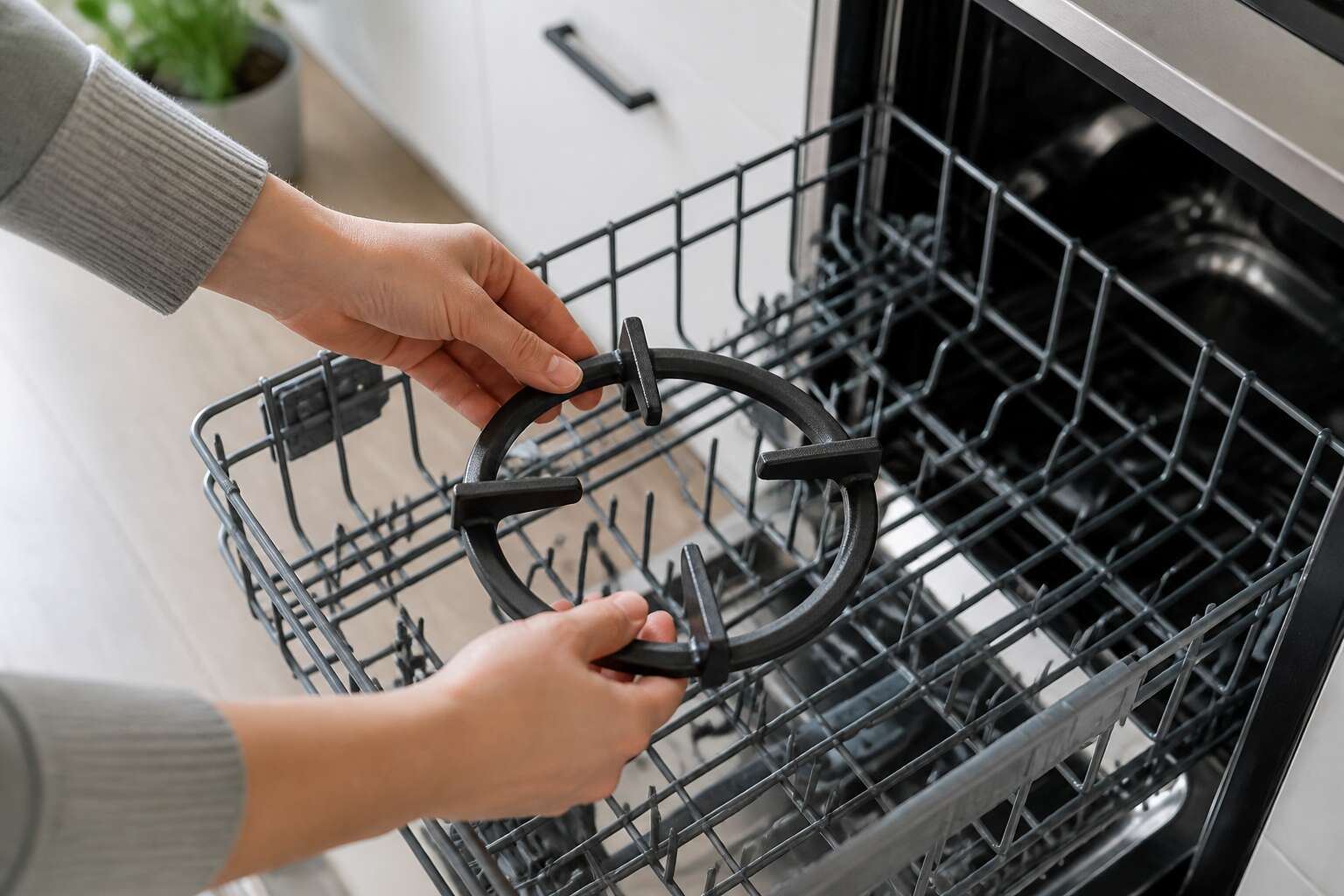
How Gas Burners Are Constructed
Materials Used in Burner Caps and Bases
Gas burner construction begins with the cap and base, two pieces that shape flame and gas flow. Brass caps are common because they distribute heat consistently. Aluminum bases appear in budget models, while stainless steel is used for modern designs.
- Brass: durable and corrosion resistant.
- Aluminum: lighter but prone to pitting.
- Stainless steel: tough yet sensitive to detergents.
These materials determine whether can gas stove burners go in dishwasher. Heat treatment and protective coatings matter too. A brass cap can tolerate moisture better than an aluminum base. However, the dishwasher’s chemicals may still degrade the finish over time. That is why checking the manufacturer’s guidance before loading burners into the machine is essential.
The Function of the Burner Ports and Slots
When you lift a burner cap, you see the base underneath with tiny openings. These are the ports. They are precisely drilled or stamped to control gas flow. The slots along the edges allow air to mix with gas before ignition. Without clean ports, flames become uneven and take on a yellow tint.
Because these openings are narrow, food residue can easily block them. That is why many people wonder can gas stove burners go in dishwasher. A dishwasher’s spray might not reach inside every port, and the detergent could leave a film that interferes with combustion.
Here is what matters for maintenance:
- Ports need manual brushing with a wire pick.
- Slots require gentle scrubbing instead of soaking.
Heat treatment during manufacturing gives the base its rigidity. The cap fits snugly over this structure, creating a sealed chamber for gas to pass through. This assembly looks simple, yet every groove plays a part in an even flame.
Why Food Debris Accumulates in Burners
A gas burner is a precision assembly. The base contains a venturi tube that draws air into the gas stream. This tube feeds a chamber that distributes fuel evenly. The cap is machined to a tight tolerance and seats onto the base, forming a sealed interface. That interface determines the pressure and flow.
Boilovers and splattered oil are the usual culprits. When a pot boils over, starchy water flows down the sides and seeps into the crevices between the cap and base. Grease from frying lands on hot metal and bakes into a hard film. Over time, this residue combines with dust and lint, forming a stubborn paste that clogs the narrow passages. I have seen burners that look clean on the surface yet hide a gritty layer underneath.
Common debris sources include:
- Starchy water from pasta or rice
- Oil splatters from frying
- Food crumbs from stirring
This accumulation is why many homeowners wonder can gas stove burners go in dishwasher. The baked-on film often resists a simple rinse, demanding a more thorough clean.
Common Signs Your Burner Needs Cleaning
A modern burner assembly includes more parts than the eye sees from above. Beneath the cap sits the burner ring with its precisely drilled ports. The ignition electrode, a ceramic tipped probe, sits beside the ring and generates the spark that lights the gas. The burner head screws into a gas supply tube running through the stove’s base.
Signs that your burner needs cleaning are easy to spot:
- Yellow flame tips indicating incomplete combustion
- Delayed ignition with clicking that lasts several seconds
- Flames that lift off the port openings
- A burner that only lights on one section
I have seen all four of these faults trace back to blocked passages. That is when homeowners ask can gas stove burners go in dishwasher, a question best answered by examining the burner construction itself.
Evaluating Dishwasher Safety for Burner Components
Manufacturer Instructions and Warranty Implications
Whether you can gas stove burners go in dishwasher depends on the alloy and the manufacturer’s instructions. Many brands, especially those with brass or aluminium components, explicitly forbid it. Caustic detergents can trigger a chemical reaction, leaving a dull film or pitting the metal surface. This is not merely cosmetic; it can alter the burner’s fit and create a dangerous gap. The question of can gas stove burners go in dishwasher becomes a risk assessment, not a cleaning shortcut.
Your warranty is the deciding factor. If the manual prohibits it, a dishwasher cycle invalidates any claim. Some manufacturers inspect the burner for detergent residue and deny coverage without explanation. Check the underside of the base for a stamp or consult the online manual. Reading the fine print is cheaper than replacing a component.
- Corrosion from detergent is typically classified as user negligence.
- Heat discolouration is not covered under standard warranties.
- Replacement parts often cost more than a professional cleaning service.
Potential Damage from Dishwasher Detergent and Heat
Evaluating dishwasher safety for burner components demands a hard look at heat and detergent chemistry. The caustic compounds in dishwasher pods are designed to strip baked-on grease, but they do not discriminate. They also strip the protective patina from brass and oxidise aluminium surfaces. High water temperatures, combined with the drying cycle, can push thin metal past its tolerance. The question of can gas stove burners go in dishwasher becomes a puzzle of thermal expansion and chemical attack, not convenience.
I have pulled burner caps out of machines that looked immaculate. A week later, they developed white, chalky streaks. That is not water spotting. That is detergent etching the alloy at a microscopic level.
- Heat can anneal the metal, making it softer and prone to bending.
- Detergent residue hides in crevices and reacts with the next cooking session.
- The drying cycle accelerates corrosion that is invisible until the part fails.
So, can gas stove burners go in dishwasher without immediate failure? The honest answer is that you often cannot tell until the warranty window closes. Once the finish oxidises, the damage is permanent and classified as misuse. A burner that warps by even a millimetre can leave a gap that allows gas to escape unevenly. That is a safety flaw you cannot polish away.
Rust and Corrosion Risks for Cast Iron Parts
Cast iron components force a different conversation. The metal is porous, so it drinks the water the dishwasher recirculates. Rust begins the moment the protective coating fails.
Consider what happens inside the machine:
1. The detergent strips the seasoning from the iron.
2. Pressurised water forces moisture into the pores.
3. The heating element bakes the moisture deeper.
4. The corrosion cycle repeats each time you run it.
The question of can gas stove burners go in dishwasher becomes a question of whether you accept this slow decay. I have removed cast iron burner rings from dishwashers. They looked solid on the outside. Within a week, flakes of rust appeared on the surface where the finish had failed. Those flakes are the metal itself, shedding away.
So can gas stove burners go in dishwasher without consequence? For cast iron parts, the answer is no. The corrosion is permanent. It continues long after the part has left the machine.
What Happens to Ports During a Wash Cycle
Every wash cycle unleashes jets of water at pressures far beyond what a stove burner ever experiences in daily use. The ports, those precise apertures that shape the gas flame, are the first to suffer. Pressurised spray drives detergent into the narrow channels, and the machine’s heat bakes the residue into the walls.
So when a South African homeowner asks whether can gas stove burners go in dishwasher, the evaluation must centre on these pathways. The wash cycle forces moisture into every recess. Without a full drying protocol, the ports remain wet long after the cycle ends.
Consider what the cycle subjects each burner to:
– Pressurised spray entering at angles the burner never faces during normal cooking
– Detergent foam that settles inside the slots
– Residual moisture that evaporates unevenly, leaving mineral deposits
The ports show the first signs of degradation. The real question is whether the component still functions after the ordeal.
Alternative Cleaning Methods That Are Proven Safe
The Soapy Water Soak Routine
While the question can gas stove burners go in dishwasher often centres on convenience, the soapy water soak routine remains the quiet champion. I fill a deep basin with warm water and add a squirt of mild dish soap. Submerge each burner cap and base completely.
Thirty minutes of soaking softens cooked on grime. Then I work a soft bristled brush around every opening. A thorough rinse under running water follows.
- Always detach burners from the gas supply first
- Use warm water, not boiling
- Dry every part fully before reassembly
This method keeps enamel and alloy finishes intact. It cleans thoroughly without exposing components to the harsh detergents and heat that trouble homeowners.
Using a Soft Brush to Clear Ports
When someone asks can gas stove burners go in dishwasher, I usually divert them to a soft brush and ten minutes of focused work. The ports on modern burners are precision cut. A gentle hand with a nylon brush preserves their exact dimensions where a violent wash cycle cannot.
Work from the underside where the opening is wider. Insert the brush at a slight angle and rotate it clockwise as you draw it back. This motion lifts the oily film that hot water alone cannot shift. I keep separate brushes for the small ports and the long slots, because cross contamination spreads the grime you are trying to remove.
- Inspect the brush tip after every pass
- Replace the brush once bristles start to splay
- Store brushes in a dry spot near the stove
Vinegar and Baking Soda Deep-Clean Technique
Vinegar and baking soda offer a chemical clean that sidesteps the question of can gas stove burners go in dishwasher entirely. I mix a paste from white vinegar and bicarbonate of soda, then coat the burner base and cap. The fizzing action lifts carbonised residue without abrasive scrubbing. Let it sit for twenty minutes, then rinse with warm water. This targets compounds that resist washing:
– It dissolves the polymerised oils that hot water cannot
– It neutralises acidic residue from food
– It softens burnt deposits for easy removal
For stubborn blockages in the ports, I apply the paste with a syringe to force it into the narrow channels. This preserves the metal’s finish and avoids caustic dishwasher detergents. It also removes the need to disassemble anything beyond what your hand holds. The result is a burner that functions as intended, no machine required.
Removing Stubborn Grease with Degreasers
When you ask can gas stove burners go in dishwasher, you quickly realise machine detergent cannot dissolve polymerised grease. A dedicated degreaser, formulated with solvents or alkaline agents, breaks that bond chemically. Personally, I keep a citrus-based spray for routine maintenance and a heavy-duty alkaline gel for caked-on residue.
The process is straightforward. Apply the degreaser to the burner base and cap, allow it to dwell for fifteen minutes, then wipe with a microfibre cloth. For ports that remain blocked, I use a thin nozzle to direct the solution into each opening.
- Citrus-based degreasers for light to moderate buildup
- Alkaline degreasers for carbonised layers
- Solvent-based products for stubborn baked-on grease
These products avoid the corrosion risks associated with dishwasher cycles, keeping the metal intact and the ports clear.
Drying and Reassembly Best Practices
A surprising number of homeowners ask can gas stove burners go in dishwasher, yet the more informed inquiry concerns what happens after the cleaning step. Ultrasonic baths and handheld steam wands offer proven alternatives that reach deep into threaded areas where brushes cannot travel. These methods use no abrasive action, preserving the factory finish on modern alloys.
Drying demands discipline! I pat each burner dry, then use a compressor nozzle or a hair dryer to force trapped moisture out of the small apertures. Skipping this step invites mineral spotting and slow oxidation. Reassembly follows a sequence. The locating pins align with their recesses, the cap seats firmly, and a gentle rotation settles the component into place.
A misaligned burner produces a yellow flame, a clear sign to restart the process. The extra minutes spent ensuring a dry, correctly seated burner pay dividends in even cooking and consistent gas pressure.
Cleaning the Igniter and Other Electrical Parts
The electric igniter is the most delicate component on the stove top, and it is where the question can gas stove burners go in dishwasher meets a firm negative. Water and high voltage are a dangerous pairing. Soap residue on the electrode can mute the spark completely.
For repeat offenders, adopt this sequence:
- Remove the burner cap and base to expose the igniter.
- Disconnect power and wait for residual charge.
- Sweep the ceramic base with a dry brush.
- Dampen a cotton swab with pure isopropyl alcohol and touch the metal tip.
The alcohol evaporates fast, leaving no film. I never allow liquid to pool around the spring or insulation. The contacts under the stove top deserve the same restraint. A dry cloth wipes away grease without introducing moisture to the wiring. A few patient minutes with a cotton bud outperform any water bath.
Step-by-Step Manual Cleaning Process
Preparations Before Removal
A clean burner starts long before the brush meets the metal. The question of can gas stove burners go in dishwasher tempts many homeowners, yet the manual route preserves the part. Preparation prevents frustration. First, confirm the stove is fully cool. Heat warps the base and makes removal difficult. Clear the cooktop of grates, knobs, and loose debris. Then gather a soft cloth, a small bowl of warm water, and a stiff nylon brush.
Position yourself with good lighting. Inspect the burner layout carefully, because each cap sits in a specific orientation. I always photograph the arrangement on my phone before lifting anything. Once removed, place screws and small fittings in a labelled container.
Follow this order for safe removal:
- Disconnect the power or gas supply.
- Lift the cap straight upward.
- Slide the base out gently.
Cleaning the Burner Cap and Base Separately
Standing at the sink with a burner base in hand, you might wonder if this is where can gas stove burners go in dishwasher. It is not. The cap and base face different enemies. The cap takes the direct flame, leaving carbon crust. The base protects the ports that turn gas into a steady blue ring.
Give the cap a warm, soapy soak for ten minutes. A nylon brush handles the residue without scratching the finish. Rinse, then move to the base.
The base asks for patience. If the igniter electrode lives there, keep it dry. Wipe the base with a damp cloth, then use a toothpick to clear every port.
1. Brush the base gently so the brass fittings stay true.
2. Dry the electrode with a soft cloth.
3. Leave both pieces out to air dry completely.
Manual cleaning shows what a dishwasher would hide. Air drying uses no electricity, a small mercy during load shedding. Once you inspect the ports yourself, the dishwasher question answers itself.
Reassembling and Testing the Burner
The real work starts when the burners go back together. Reassembly demands a steady hand, not a quick shrug. Lower the base into its cradle and check that the igniter electrode stays dry and untouched. Then seat the cap so it rests without a wobble. A tilted cap changes the flame shape and wastes gas.
- Fit the base and confirm the electrode has no water beading.
- Place the cap and press down until it sits level.
- Light each burner at low flame and observe the ring.
Testing gives you the quiet verdict. A clean, blue cone means the ports are open and the mix is right. An orange or yellow tip signals trapped debris or dampness in the fitting. This is the practical answer to whether can gas stove burners go in dishwasher; the machine does not inspect what it cannot see. Your own hands, however, can feel the difference after each manual cleaning, and that is the reassurance no spin cycle offers.
Maintenance Tips to Extend Burner Lifespan
Regular Wipe-Downs after Cooking
Most people don’t think about the thin film of oil left behind after a quick stir fry. That film bakes onto the burner ring during the next ignition, turning into carbon. A simple wipe down after each cooking session prevents this. It also removes the need to ever wonder whether can gas stove burners go in dishwasher. I keep a damp cloth on the counter and give each burner base a quick pass once the cooktop cools enough to touch.
Focus on the seam where the cap meets the base, since grease pools in that crevice. A few seconds of wiping there saves hours of soaking later. This small habit alone keeps most burners functional for years. When you regularly remove residue while it is still soft, the answer to can gas stove burners go in dishwasher barely matters. You simply won’t need that aggressive method. Routine maintenance makes dishwashers unnecessary for stovetop components.
Avoiding Abrasive Cleaners
Steel wool and scouring pads might seem efficient, but they are the quickest way to shorten a burner’s life. These abrasives scratch the metal, leaving microscopic grooves where grease embeds permanently. Once that protective surface is gone, the question of can gas stove burners go in dishwasher becomes a costly dilemma. I have seen good burners ruined by aggressive scrubbing.
Consider the chemistry. Many scouring powders contain chlorides, which attack aluminum and brass. A soft sponge with warm water outperforms any abrasive paste. Patience is the real tool.
Here are guidelines for daily upkeep:
Use a non-abrasive sponge or microfiber cloth.
Avoid metal scrapers.
Check the cleaner label for pH warnings.
These choices keep port edges sharp and gas flow even. Reach for a scratchy pad and you invite corrosion. Respect the metal, and it respects your cooking routine.
Inspecting Ports for Clogs Monthly
Monthly port inspection is the quiet discipline most homeowners skip. A toothpick or a thin wire, not a drill bit, clears the tiny openings that direct flame. When you wonder can gas stove burners go in dishwasher, remember that a dishwasher never reaches the interior of those narrow passages. The question matters less than the habit of checking.
Look for discoloration around each port, which signals uneven gas flow. Also feel for a soft, powdery residue, a sign of early corrosion.
Here is what a quick inspection should cover:
- A clean, dry toothpick for each port.
- A flashlight to see deep into the slot.
- A soft cloth to wipe the surface after clearing.
This monthly ritual takes five minutes. It prevents the slow buildup that turns a simple cleaning question into a replacement cost.
When to Call a Professional
Every technician has a story of a gas stove burner destroyed by devotion. The owner scrubbed it, polished it, and even ran it through a dishwasher! Dishwashers create a humid microclimate that seeps into fittings. Corrosion follows. That is why the question can gas stove burners go in dishwasher needs care. I find a full day of air drying matters more than any cleaning product.
When to call a professional? Listen for irregular flames or delayed ignition clicks. When cleaning cannot stabilise the flame, you have crossed into professional territory. A technician can measure gas pressure and inspect valves. It is worth the fee.
Habits that extend burner life:
- Use correctly sized pots to keep flames under the pan.
- Oil bare metal surfaces after every cleaning.
- Replace warped bases before they damage the valve.
When you smell gas, skip the troubleshooting. Open windows, leave the house, and call the supplier.




0 Comments