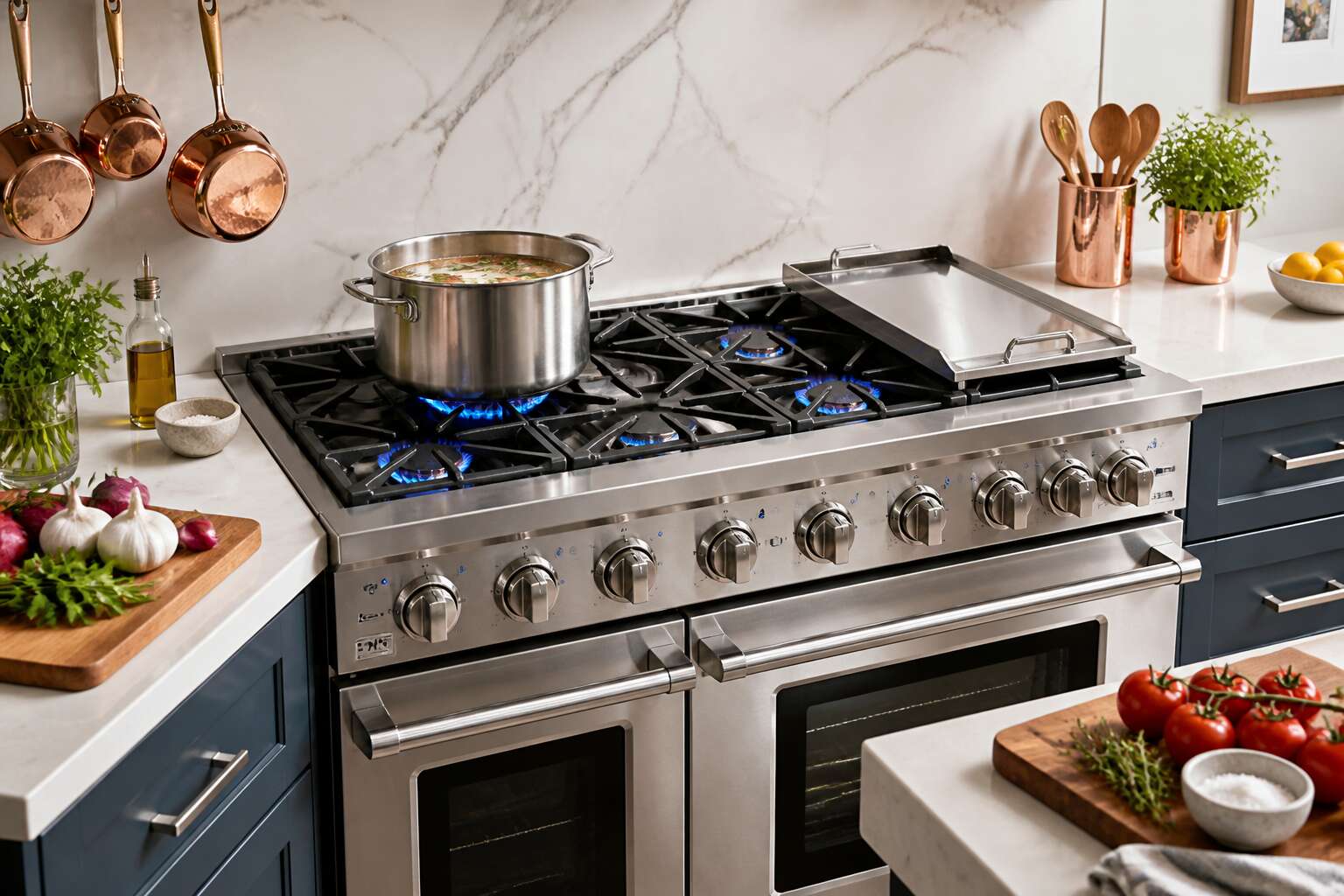
Evaluating Your Cooking Space and Needs
Kitchen Layout and Floor Plan
A standard South African kitchen cabinet is built around a 60 cm oven. That setup suits the casual cook, but a 6 burner gas stove brings different requirements. The unit needs 90 cm or more of counter width, plus clearance for gas lines and ventilation hoods. The depth of the appliance also affects how far it protrudes from the cabinet face.
Before buying, the floor plan deserves close attention. The distances from the stove to the refrigerator, sink, and work surface matter. The ideal triangle still matters, but so do door swings and drawer paths.
- Width of the intended cabinet opening
- Depth from the wall to the counter edge
- Height from the floor to the gas connection point
The kitchen layout and floor plan also need to account for heat. A 6 burner gas stove radiates more heat than smaller models. That affects nearby cabinetry and the comfort of anyone standing at the side burners. The cooking space needs careful evaluation before installation.
Fuel Source and Hookup Constraints
Evaluating your cooking space goes beyond counter width. A 6 burner gas stove demands serious heat management. You need to consider how often you run all six burners at once. My own kitchen trial revealed that searing and simmering produce different vapor loads. That changes your ventilation requirements.
For fuel source, check what your municipality supplies. Natural gas and LPG behave differently. Here are the critical constraints:
- Gas line diameter and pressure rating
- Connection point location and access
- Compliance with South African standards
Before installation, confirm the regulator matches your appliance. The unit consumes more gas per hour than typical home versions. That affects pipe sizing and storage placement for cylinders. Skipping this step leads to weak flames or safety hazards.
Required Clearance and Ventilation
Your kitchen’s air has a limit. I underestimated the volume a 6 burner gas stove displaces. A full flame load produces steam and grease vapor that tests even a powerful extraction hood.
Clearance demands vary with the material. Remember three critical zones for your installation:
- 150 millimetres from combustible side surfaces
- 100 millimetres from the rear wall
- 750 millimetres for a range hood above the burners
Non combustible backsplash materials can reduce some of those figures, but only with certified panels.
Ventilation must match your usage patterns. Searing six pans creates a different vapor signature than slow braises. Give your extraction system capacity to cycle that air efficiently.
Understanding Performance Drivers
BTU Output and Thermal Efficiency
Two identical 6 burner gas stoves can have wildly different price tags. The difference comes down to how each unit converts gas into actual cooking power, not the number of flames on top. Understanding BTUs and thermal efficiency will save you from overpaying for a pretty face.
BTU output measures raw energy appetite. A burner rated at 18,000 BTUs can drink fuel faster than a 12,000 BTU sibling. But raw appetite means nothing if the heat goes sideways instead of into your pot. That is where thermal efficiency enters the conversation. It is the translation layer between gas consumed and heat delivered to your food.
A 6 burner gas stove with impressive BTU numbers but poor efficiency will slow boil your water and inflate your gas bill. A well designed burner directs flame contact precisely, wasting less heat into the surrounding air. High end models often use:
– Sealed burner caps to prevent heat loss
– Optimised flame ports for consistent distribution
– Heat diffusers that spread energy evenly across pan bases
The oven cavity on a 6 burner gas stove deserves equal scrutiny. A powerful oven that leaks heat through a poor seal will struggle to maintain temperature. That struggle uses more gas and yields uneven baking. The finest burner configuration in the world cannot fix a badly insulated box.
When comparing models, ignore the total BTU count and focus on efficiency ratings. A unit that delivers 70 percent of its potential heat to the pan will outperform a brute that only manages 45 percent. Look for stoves that feature flame control technologies and heavy cast iron grates, as these components retain and radiate heat more effectively. We can obsess over the number of jets until we are blue in the face, but what actually matters is how much heat lands in your food. That is the true performance driver.
Heat Distribution and Turning Zones
When you stand before a 6 burner gas stove, the eye counts six identical circles. The hand knows better. Heat distribution across the grates is rarely uniform. The rear left burner may run fierce while the front right idles, a quirk caused by gas rail lengths and internal jet placement. A well designed cooktop gives each burner a distinct role.
Turning zones matter more than maximum flame. Dialing from a violent boil to a gentle murmur requires precise valve adjustment. Cheaper units tend to jump between settings. Look for valves with a long taper and stable low output. The best stoves sustain a small, steady flame that does not extinguish when a pot slides onto the grate.
- Burner cap alignment directs flame spread
- Spider guards prevent clogging from spills
- Dedicated simmer burners extend the low heat range
These details turn a 6 burner gas stove into a usable workspace.
Sealed Ranges vs Open Burners
Most 6 burner gas stove buyers obsess over flame size, yet the real performance driver is burner construction: sealed ranges versus open burners.
Open burners expose flame to surrounding air. Sealed ranges enclose the combustion zone beneath a cap. Both have merits under real conditions.
Sealed burners direct flame through a fixed cap. This creates consistent heat distribution and stops chutney from boiling into the gas lines. Open burners draw more secondary air, which boosts raw output but leaves flame height vulnerable to draughts.
Consider these performance drivers:
- Sealed burner caps need exact alignment.
- Open jets require larger clearance.
- Flame failure devices respond faster on sealed units.
The 6 burner gas stove in a South African kitchen must handle power failures, windy stoeps, and heavy cast iron. Your patience with cleaning, not the size of the flame, decides which burner design wins.
Grate Design and Cookware Contact
In a rural Karoo kitchen, a broken grate often ends a recipe before the flame does. The 6 burner gas stove deserves a solid foundation for your pots, because heat transfer depends on direct physical contact.
Grate design determines how well a pan sits. Look for cast iron prongs spaced narrowly enough to support a small milk pot, yet strong enough for a 12 kg cast iron pot. Thin steel grates bend over time, causing the cookware to wobble and tilt. That tilt turns a simmer into a scorch.
- Match the grate pattern to your most used pot sizes.
- Test that the pot’s flat bottom touches at least three points evenly.
- Inspect the grate after cleaning for warped arms.
Cookware contact matters more with a 6 burner gas stove than with smaller units. A rounded wok stays wobbly. A flat, thick aluminium base locks onto the heat. Your attention to these details, not the knob position, decides the final meal.
Automatic Re-Ignition and Flame Supervision
Here is a fact worth more than your fire extinguisher: a flame that dies while gas keeps flowing will ruin a kitchen faster than a load-shedding schedule. Flame supervision devices exist to stop that. On a 6 burner gas stove, a thermocouple senses the heat and cuts the gas when the flame goes out. A pot boiling over will not turn your stove into a methane lagoon.
Automatic re-ignition works in reverse. The spark electrode pulses until the flame catches. A gust through the window kills the burner, and the stove relights itself before you can complain.
- Hold the knob for five seconds after ignition to let the thermocouple warm up.
- Listen for a steady clicking sound. A hesitant spark usually means a dirty electrode.
- Clean the electrode tip with fine sandpaper every few months.
Performance depends on these response times. A slow safety cut-off wastes gas; a fast one saves your kitchen. When comparing a 6 burner gas stove, test the flame supervision valve before you buy. If there is a delay, walk away.
Installation, Care, and Durability
Hiring a Professional for Gas Lines
According to the South African Gas Association, a poorly connected gas range is the leading cause of kitchen fires. That statistic alone justifies hiring a certified professional for your 6 burner gas stove, because this unit draws serious fuel. Professional installation isn’t a luxury; it is a non-negotiable rite of passage for anyone who values their eyebrows.
Care routines are straightforward. Wipe the grates after each use, and deep clean the burner caps monthly. Durability depends on the materials. Cast iron grates last decades; enameled steel chips less but demands gentle handling. Here is a maintenance order for the forgetful among us:
1. Shut the gas valve at the wall.
2. Remove and soak the burner caps in warm soapy water.
3. Scrub the ports with a soft brush.
4. Dry everything completely before reassembly.
The internal gas tubing on a 6 burner gas stove needs annual inspection for stress fractures. South African humidity accelerates corrosion on exposed fittings, so a silicone seal around the joint pays for itself. Skip no steps. A lazy approach turns your kitchen into a chemistry experiment with unpredictable results.
Routine Cleaning for Stainless Finishes
Stainless steel finishes on a 6 burner gas stove repel fingerprints only if you treat them with respect. Abrasive cleaners leave micro-scratches that catch grease and dull the surface over time. Use a microfiber cloth and warm water with a drop of dish soap. Wipe along the grain, not in circles, and dry immediately to prevent water spots.
For everyday maintenance, keep a spray bottle of diluted vinegar near the cooktop. A quick mist after cooking dissolves the invisible film of oils. Once a week, apply a food-safe stainless polish to rebuild the protective layer. The polish also fills tiny pores where rust could start.
Installation matters for the finish too. A certified fitter handles the heavy unit without scratching the panels or kinking the internal lines. The 6 burner gas stove sits level, so moisture never pools on the surface. That single detail extends the life of the steel.
Seasoning Cast Iron Grates
The cast iron grates on a 6 burner gas stove endure a harsh existence. Each cooking session sears oils into their porous surface. The proper response is to season them deliberately.
- The grates are heated until they emit a faint smoke.
- A thin layer of neutral oil is rubbed across all surfaces.
- They cool gradually in the oven.
- The process repeats after every deep cleaning.
This builds a polymerized layer that repels moisture and prevents rust. A seasoned grate becomes naturally nonstick, and its durability increases with each use. The installation of your 6 burner gas stove also matters. A level cooktop ensures even flame contact across all grates, so the seasoning cures uniformly. An unlevel unit causes hot spots, making the oil breakthrough and the metal vulnerable. Cared for this way, the grates outlast every other component.
Diagnosing Common Flame Noises
A quiet flame is a reliable flame. The difference between a well tuned burner and a troubled one is often measured in decibels, not degrees. On a 6 burner gas stove, every sound carries information.
Listen closely. A low roar suggests the air shutter is too far open, and a spitting or popping noise points to moisture inside the burner body. Whistling often signals a partially blocked venturi tube where insects build nests. None of these noises mean the stove will fail. They mean it needs care, and that is good news!
- Roaring flame: an over open air shutter.
- Popping flame: a wet burner cap or a blocked jet.
- Whistling flame: a partially blocked venturi tube.
In my experience, durability comes from correcting these conditions early. A stove installed with the correct regulator pressure and clean internal passageways runs quietly for years. An unfamiliar note usually means a small adjustment is overdue.
Replacing Burner Components Over Time
Installing a 6 burner gas stove properly matters more than most owners realise. The burner components face direct flame on every use and wear out over time. A warped cap distorts the flame pattern. A corroded jet changes the gas flow. These parts are replaceable, and that is the good news!
Replace the burner cap and ring when you see cracks or discolouration. The jet, which meters the gas, should be checked whenever you remove the burner assembly. In coastal South African homes, salt air accelerates corrosion, so annual inspection is wise.
- Turn off the gas supply at the regulator.
- Lift the burner cap and ring from the base.
- Inspect the jet with a torch light.
- Fit genuine replacement parts only.
A 6 burner gas stove that receives this care returns years of quiet service. Parts are cheap. Ignoring them means poor cooking and uneven heat.
Warranty Considerations and Service Contracts
Installation determines whether your 6 burner gas stove earns its warranty. A certified installer should check the regulator pressure and confirm the unit sits level. Any misalignment strains the gas rail and can lead to uneven flames.
Care goes beyond surface cleaning. An annual service appointment, where the technician inspects the ignition module and tests the oven thermostat, prevents small faults from becoming costly repairs. We recommend scheduling this before winter.
Durability depends on both build quality and upkeep. Warranties usually cover 12 months, but a service contract becomes worthwhile in the third year. Consider these inclusions:
- Two scheduled inspections per year
- Priority response for breakdowns
- Replacement of worn seals and gaskets
Compare contracts carefully, because some exclude the expensive electronic ignition board. That protection matters for a 6 burner gas stove used daily.
Budgeting and Upgrading Your Kitchen
Price Tiers and High-End Options
The price gap between a basic and premium 6 burner gas stove often exceeds R20,000 in South Africa. That spread forces you to consider what your kitchen needs before spending.
Price tiers break down by materials and conveniences:
- Entry tier: painted body, compact oven capacity
- Mid tier: stainless steel, larger oven window
- Premium tier: modular builds, custom colour finishes
Upgrading your kitchen means weighing these tiers against cooking frequency and home resale value. The premium tier suits households that host large gatherings or run a small catering business. For most families, the mid tier delivers the best balance of cost and daily practicality.
Balancing Features Against Cost
Budgeting for a 6 burner gas stove in South Africa is an exercise in restraint. The allure of a commercial grade appliance can tempt you into overspending, but the real cost lives in installation, ventilation, and ongoing maintenance. A sensible approach allocates funds to the stove itself, then reserves a portion for professional gas line work and durable cookware.
Consider what your household actually demands. A 6 burner gas stove with heavy cast iron grates and automatic re-ignition will serve most families for decades. Paying extra for modular builds or custom colours only makes sense if those features align with your cooking habits.
When the budget tightens, prioritise safety and durability over aesthetics. The cheapest option may lack flame supervision, which is a non negotiable in modern kitchens. The most expensive option may include conveniences you rarely use. The right choice balances these extremes against your actual cooking patterns.
Energy Efficiency and Operational Savings
South African households spend a staggering portion of their monthly income on electricity, a fact that makes the shift to liquefied petroleum gas feel less like a luxury and more like a survival tactic. The irony is that you will spend a significant sum on a 6 burner gas stove, only to realise that the real savings appear on your municipal bill, not the price tag. Those high output burners are not just for show; they transfer heat directly into the pan instead of radiating it into the Johannesburg Highveld air. A well maintained 6 burner gas stove, fitted with a proper regulator, will outperform a standard electric oven in both speed and cost per meal.
Upgrading your kitchen to accommodate this heat source often forces a broader conversation about energy efficiency. You might install a pot filler or a high powered extractor fan, but the operational savings come from the burner design itself. The ability to simmer a pot of chakalaka on a single low flame without wasting the other five burners is a form of financial discipline. To maximise the efficiency of your 6 burner gas stove, consider the following adjustments:
– Always match the pot diameter to the burner size to avoid heat spillage.
– Use flat bottomed cookware; warped pans waste fuel and cook unevenly.
– Keep the burner caps clean to ensure a crisp, blue flame instead of a lazy yellow one.
The upfront capital for installation can sting, but the operational cost of gas versus electricity in 2024 favours the flame almost every time. Ignoring the thermal efficiency of your chosen model means you might buy a cheaper unit that burns fuel poorly, negating any savings. A high end 6 burner gas stove with sealed burners prevents heat from escaping under the grate, funneling all that energy into your pot of stew. Meanwhile, the oven cavity, if well insulated, retains heat so effectively that you can turn it off ten minutes before the bread finishes baking. The real budget upgrade is not the appliance itself, but the monthly savings that accumulate while you cook like a professional chef without a utility bill shock.
Matching the Cooktop to Your Cooking Style
Your cooking style should dictate how much you invest in a 6 burner gas stove. A household that hosts Sunday gatherings needs the full surface, while a couple who cooks twice a week might allocate budget elsewhere. The price gap between entry level and premium models is substantial, and that difference often funds better pots or a decent extractor fan.
Consider the burners you actually use. Many South African cooks rely on two high output burners and one gentle simmer zone. Paying extra for six identical high output burners only makes sense if you regularly run multiple large pots. A 6 burner gas stove with mixed burner sizes matches real cooking demands. Budget realism means buying the configuration that fits your routine.
Accessories and Griddle Enhancements
Walk into any appliance showroom in South Africa and you will see a gleaming 6 burner gas stove on display. The accessories around it tell you what cooks actually need. Most buyers invest their entire budget in the range itself, leaving nothing for the griddle enhancements that turn a large cooktop into a usable workspace.
A reversible griddle plate, for instance, spans two burners and gives you a flat surface for boerewors or breakfast toasties. Your budget should account for these extras before you sign for the stove. Consider this order of investment:
- a heavy cast iron griddle
- a sturdy grill press
- a counter rack for resting hot pans
Prioritising these items alongside the stove makes it a daily tool instead of a Sunday showpiece.


0 Comments