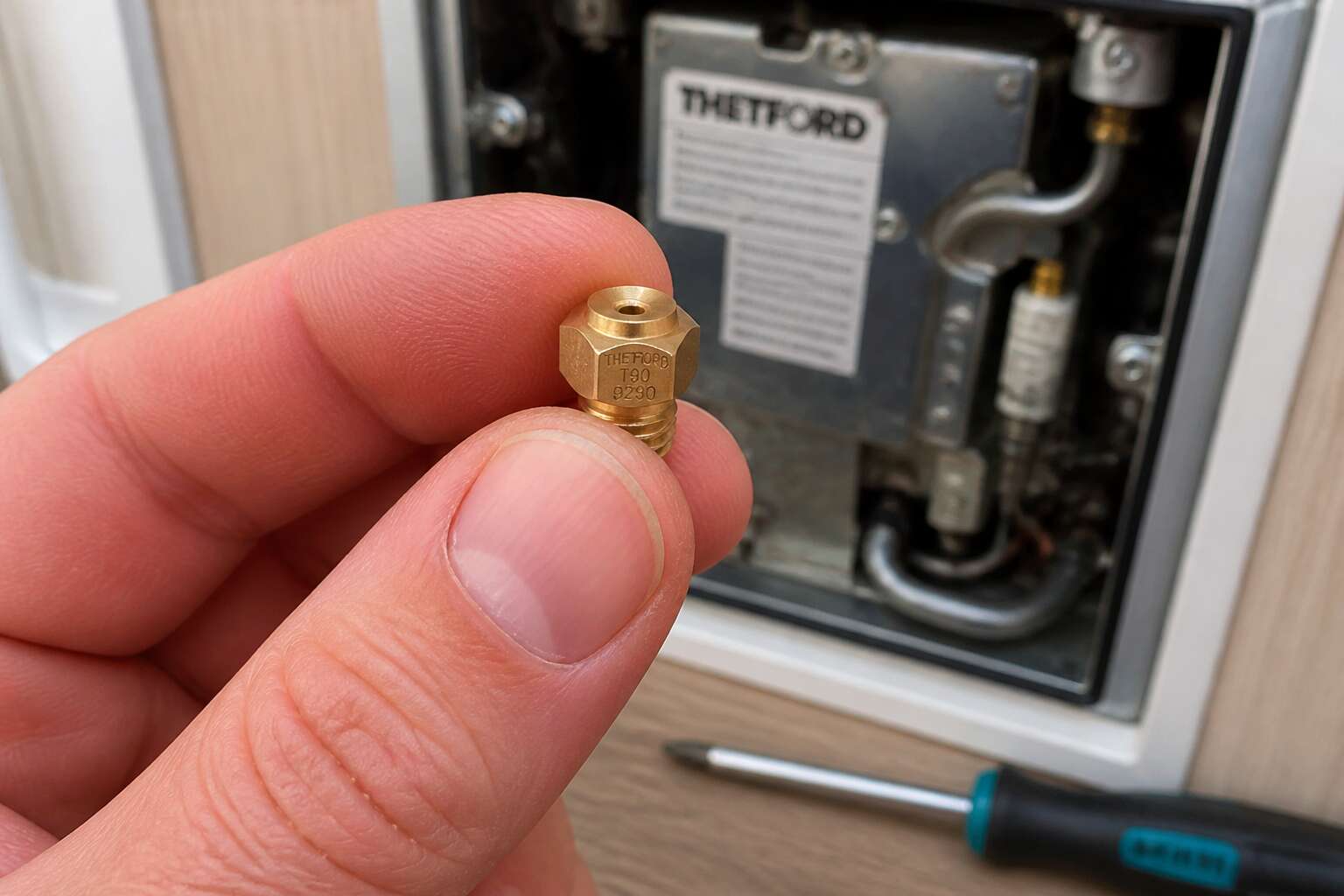
Understanding the Function of a Refrigerator Gas Jet
What Does the Gas Jet Do in an Absorption Fridge?
The sealed interior of an absorption fridge hides a small component that decides everything. The thetford fridge gas jet is a brass orifice, drilled to an exact diameter, which meters liquid petroleum gas into the burner. In a caravan refrigerator, this jet governs the flame. Without a reliable flame, the ammonia solution never boils, the condenser never cools, and the box turns warm.
A jet answers a series of specific demands:
- Fuel volume per second must remain constant.
- Vapour pressure must enter the burner evenly.
- Soot deposits must not shrink the opening.
When the thetford fridge gas jet narrows from carbon build-up, the cooling output drops in silence. The system gives no error code. It simply fails to keep your food safe. That is why understanding this tiny component matters.
How the Jet Works with the Burner Assembly
One millimetre of misalignment can ruin your caravan fridge’s performance. The thetford fridge gas jet sits inside the burner assembly as the sole controller of gas flow. From its tiny brass opening, vapour enters the venturi throat where it meets the primary air drawn through the shutter.
This alignment is delicate. The jet tip must sit at a specific distance from the throat. Too close, and the flame roars. Too far, and it sputters! The assembly includes the injector holder, the mixing tube, and the flame spreader. Each component depends on the jet’s exact position.
When the caravan refrigerator runs quietly, the jet is doing its job. The burner assembly converts liquid petroleum gas into a steady flame. That flame carries heat into the boiler, where the absorption cycle begins.
Symptoms of a Failing Gas Jet
The quiet is the first warning. A caravan fridge that once hummed now sits silent. Silence is never neutral. The thetford fridge gas jet governs every vapour flow, and when it weakens, the absorption cycle falters with it.
A failing jet shows itself in subtle ways:
- The flame turns yellow instead of blue.
- Soot gathers on the burner.
- The fridge cycles on and off, unable to hold temperature.
These symptoms share one root. The gas jet’s opening has narrowed, clogged by residue left behind from liquid petroleum gas. Its tolerance for contamination is almost zero.
In South Africa’s dry climate, dust compounds the issue. Impurities settle into the jet’s interior. I have pulled jets from fridges that looked clean on the outside, yet the opening was sealed shut. The result is a fridge that burns gas yet delivers no cold.
Common Problems and Diagnostic Checks
Reduced Cooling Efficiency: A Key Warning Sign
Reduced cooling efficiency rarely announces itself with drama. The caravan simply feels warmer after lunch, the butter softens, the morning milk loses its chill. For many South African owners, this gradual decline is the first tangible clue that the thetford fridge gas jet needs attention. A weak flame leaves the boiler underfed, so the absorption cycle cannot complete its work. The refrigerator runs longer, yet the temperature stubbornly climbs.
A proper diagnostic routine separates simple blockage from a worn jet. Three checks matter most:
- Carbon buildup or debris on the burner assembly
- Gas pressure relative to the appliance specification
- Thermocouple response time after ignition
When these checks confirm a clean burner and correct pressure, the thetford fridge gas jet becomes the focus. Its size and condition determine whether the flame burns steadily or weakens into a yellow, sooty taper.
Visual Inspection: Cracks, Soot, and Blockages
Three out of four caravan fridge faults begin with a dirty burner, yet most owners head straight for the gas bottle. Begin with your eyes. Remove the burner cover and examine the thetford fridge gas jet under good light. Hairline fractures along the brass nozzle alter flame geometry. Soot streaks on the burner tube indicate incomplete combustion. Blockages appear as blackened crusts or spider webs in the inlet.
A simple checklist moves the inspection from guesswork to method:
- Check for visible cracks on the jet housing
- Look for soft, powdery soot around the flame port
- Probe the inlet with a clean wire for obstructions
These three observations tell you whether to replace or ream the jet, and they save you from dismantling an entire gas line on a hunch.
Testing Gas Flow Through the Nozzle
After the eyes have done their duty, the ears take over. A healthy thetford fridge gas jet sings with a soft, steady hiss through its nozzle. Listen closely when the burner ignites. A sputtering whisper or a dead silence tells you the passage is strangled or empty.
Darkness sharpens the diagnosis though. In a shaded corner, watch the flame itself. It should stand as a crisp blue needle. An orange tongue licking at the burner tube means the gas is starving for oxygen, and the thetford fridge gas jet is the gatekeeper.
When to Call a Professional
South African LPG is not pure gas; it carries trace oils that slowly bake onto metal surfaces. Over months, that film hardens around thetford fridge gas jet, reducing its bore and weakening the flame. A misaligned burner tube, after a rough caravan trip, causes similar symptoms.
Before you phone a technician, run these diagnostics:
- Test the thermocouple with a multimeter, because a failing thermocouple mimics a blocked jet.
- Check the gas pressure at the regulator using a manometer; low pressure makes the flame weak.
- Inspect the burner tube alignment after tightening any loose screws.
If these checks turn up nothing, or you smell gas at any point, stop and call a professional. Correcting a damaged or clogged jet requires precision, and a certified gas installer has the tools and training for safe repair.
Step-by-Step Gas Jet Replacement Process
Tools and Safety Precautions
Seventy percent of absorption fridge failures trace back to a blocked nozzle, yet the repair takes under an hour. Replacing a thetford fridge gas jet requires three tools: a small spanner, thread sealant, and a new jet. Work outdoors or near an open window.
- Shut off the gas supply at the bottle.
- Remove the exterior burner cover to expose the jet.
- Unscrew the jet holder, then swap the nozzle without touching its tip.
Tighten firmly but never force the threads. Test every joint with soapy water; bubbles indicate a leak. When the thetford fridge gas jet is reinstalled, light the burner and watch for a blue flame. If you smell gas at any point, stop immediately and call a qualified technician.
Locating the Gas Jet in Your Thetford Unit
Locating the thetford fridge gas jet begins with the unit’s rear panel. The jet sits inside the burner housing, tucked behind a metal shield. I find it easiest to remove the panel and trace the gas line from the bottle to the burner assembly. The jet holder is the brass fitting where the line narrows.
- Remove the rear access cover.
- Identify the burner tube running parallel to the fridge floor.
- Look for a small brass nozzle secured by a hexagonal nut.
Once found, the replacement process follows a simple order. Unscrew the jet holder with a spanner, then lift the old nozzle out. Swap in the new thetford fridge gas jet without touching its tip. Hand tighten the holder, then add a quarter turn with the spanner. Reconnect everything and check the flame pattern.
Removing the Old Jet Without Damage
Removing an old thetford fridge gas jet feels like unmaking a small machine. The job is delicate. The burner housing is cramped, and the nozzle can seize in its brass seat after years of heat cycles.
I prefer to work with the unit cold, far from any pilot light. A long spanner gives you the leverage, but patience does the real work. Tugging at the holder will only round its corners and leave you stranded. Instead, rock the fitting gently.
– Position the spanner square on the flats of the jet holder. Do not tilt it.
– Apply steady pressure in short, controlled pulses.
– Spray a penetrating fluid around the base if it resists, then wait five minutes.
Draw the lines that move gas to the flame. The brass hardware is soft, and the nozzle itself is almost delicate. This is not the place to improvise, and there is no virtue in speed.
Once the nozzle is free, do not blow through it, and do not clean it with a wire. Drop the old part into a jar and walk away. If you have a small wrench, you can grip the holder body instead of the nut. A tiny jet of flame is normal; a flickering yellow plume is not.
Thread the new thetford fridge gas jet into the holder by hand, then follow the sequence described above. The old nozzle is unforgiving and will often rust the moment it meets air. Work with clean hands and steady breath.
Choosing the Correct Size and Type
A fridge that runs on propane demands a precise orifice. The thetford fridge gas jet is a calibrated component, not a universal part. When you replace it, first confirm the fuel grade: LPG or butane. The stamp on the brass body tells you the bore size in millimetres.
Matching the new jet to your unit’s model is straightforward if you read the service manual’s parts list. I never assume a standard size fits all burners. An oversized bore produces soot and incomplete combustion. An undersized bore reduces heat output and may lock out the burner.
- Check the existing jet’s stamp before discarding.
- Confirm your Thetford model number and gas type.
- Use a new copper washer when sealing the holder.
Threading the new thetford fridge gas jet by hand avoids cross-threading. Tighten with a gentle final torque.
Reassembling and Leak Testing
After the new thetford fridge gas jet is seated, reassembly demands the same patience you used for removal. Reverse the tightening sequence, but stop before the brass feels angry. Refit the burner shield, then the access panel, securing each screw in a diagonal pattern so the gasket compresses evenly.
Leak testing is where the search for drama pays off. Mix soapy water and brush it over every joint you touched. Bubbles mean you have a gremlin, not a seal. Then run a controlled ignition and watch the flame settle into a crisp blue cone.
- Verify the jet is snug, not cranky.
- Confirm the gas valve is off before testing.
- Check for yellow flame tips after five minutes.
That routine catches most failures before your braai does. A cleanly fitted gas jet rewards you with years of quiet service.
Maintenance Tips to Extend Jet Life
Using the Fridge Regularly to Prevent Debris
An idle fridge collects debris. Dust and grease settle on the burner assembly. Weekly operation prevents this. I run my Thetford every seven days, even between trips. The heat cycle vaporizes moisture and burns off residue. That simple habit keeps the thetford fridge gas jet clear.
Maintenance goes further. Keep the flue area clean and inspect the nozzle monthly. Use a soft brush for debris, such as:
- Cobwebs and egg sacs
- Insect nests
- Dust bunnies from surrounding cabinets
These pests become carbon deposits quickly.
Regular use is the cheapest protection. A hot flame discourages debris from accumulating. Frequent ignition also keeps the internal passage polished. Neglect costs more than a five minute routine.
Cleaning the Burner Area During Annual Servicing
One missed annual service turns your caravan fridge into an expensive cupboard. The thetford fridge gas jet deserves better. During the yearly deep clean, I remove the burner assembly and give it my full attention.
Cleaning the burner area requires a steady hand and a soft brass brush. Steel wool is a crime. The flue tube interior hides a fine carbon film, which flakes off and blocks the nozzle. I also inspect the primary air opening for spider silk, a recurring menace in South African caravan parks.
For a thorough job, follow this order:
- Disconnect gas and let the unit cool completely.
- Brush the burner tube and flue base.
- Blow compressed air through the jet orifice.
- Reassemble and leak test with soapy water.
That last line is a safeguard against a weekend of warm beer. The thetford fridge gas jet stays clear.
Why LPG Quality Affects Jet Performance
In South Africa, LPG composition varies from one dealer to the next. A contaminated batch deposits a sticky film inside the burner. I have seen jets choke on residue from a single bad fill. Over time, that film hardens and constricts the thetford fridge gas jet. The narrowing is gradual. It does not announce itself until cooling fails completely.
Extending jet life depends on fuel purity. Heavy hydrocarbon residues, moisture, and sulphur compounds accelerate carbon formation. The thetford fridge gas jet’s tiny bore tolerates no impurities. Propane with a high purity rating keeps the flame clean and the bore unobstructed.
- Buy gas from high volume retailers who turn over their stock quickly.
- Inspect the regulator for diaphragm wear each season.
- Seal the burner housing against dust when the caravan is idle.
LPG quality determines how often you intervene. Poor fuel demands frequent attention. Good fuel lets the jet work undisturbed for years.




0 Comments