Understanding Gas Refrigerator Temperature Basics
Why Temperature Matters for Food Safety and Preservation
In South Africa, where load shedding disrupts electric cooling, the gas fridge temperature becomes the lifeline for food preservation. Most absorption units run best between 2°C and 4°C, while the freezer compartment needs -18°C. But gas fridges respond to heat differently than compressor models.
- Ambient temperature directly influences cooling performance.
- Frequent door openings cause slower recovery times.
- The thermostat dial rarely matches actual internal conditions.
Food safety hinges on this baseline. Above 5°C, bacteria multiply rapidly, doubling in as little as twenty minutes. A gas fridge temperature that drifts to 7°C turns leftover meat into a health risk. Preservation demands constant cold, not intermittent chill. I always advise checking with a standalone thermometer, because that gives you the truth that the factory dial hides.
Ideal Temperature Range for Gas Refrigerators
A gas fridge temperature is not a set-and-forget number. The absorption cycle relies on a flame, ammonia, and water to create cold. That chemical loop produces a gentler, more gradual cooling curve than the compressor models I grew up with in South Africa.
For the main cabinet, the ideal temperature range for gas refrigerators sits between 2°C and 4°C, with 3°C as the practical midpoint. The freezer compartment should target -18°C. That spread is the operational heart of a gas fridge temperature setup.
Several quirks define how these units hold cold:
- The flame size dictates the cooling rate, not the thermostat alone
- Gas pressure from the bottle drops as it empties, weakening the flame
- A fully stocked fridge retains cold better than an empty one
Understanding these mechanics explains why the dial feels unreliable. The flame, the gas flow, and the load inside the cabinet all shift the real conditions.
External Factors That Influence Interior Temperature
Most people assume the dial on a gas fridge temperature control is the final word on the cold. It is not. The environment around the cabinet has a greater vote than you might suspect, and it behaves in ways that surprise newcomers. In the Highveld summer, a hot room forces the cooling unit to run harder just to hold a basic temperature. The flame is constant, but the workload shifts dramatically when the ambient air around the coils climbs past 30°C.
The wind is another quiet variable. An outdoor installation near a breeze can cool the condenser so effectively that the internal temperature drops too low, while a sheltered, stagnant corner causes it to climb. The absorption cycle does not respond to these shifts with the same speed as a compressor.
– Gas quality changes boil off rates, which alters flame intensity.
– Frost buildup on the evaporator acts as insulation, slowing heat transfer.
– The thermostat sensor measures air, not food temperature, so warm jars confuse it.
The thermometer reading becomes a snapshot of one moment, not a promise. A fridge facing a western wall in a Cape Town summer responds differently than the same unit in a Durban garage. What works for one household fails for another, and the manual cannot account for your specific geographic quirks. The gas fridge temperature you observe is the sum of the flame, the pillaging pressure, and the thermal chaos of the room around it. It changes constantly, even when your setting never moves.
Seasonal Variations and How They Affect Cooling
South Africans often discover that their gas fridge temperature changes with the seasons. In the Highveld winter, the cooling unit idles because ambient air already helps the condenser shed heat. In the Lowveld summer, the same unit operates longer to hold a basic internal temperature. Spring and autumn present swings between warm days and cool nights. Understand these shifts before adjusting the dial.
- Winter can cause over-cooling if left untouched.
- Summer slows the cooling cycle.
- Transitional months require monitoring.
Acknowledging these seasonal variations prevents misreading the controls. The reading you record today might differ next month, which is normal.
Setting and Adjusting Temperature on a Gas Refrigerator
Locating the Temperature Controls
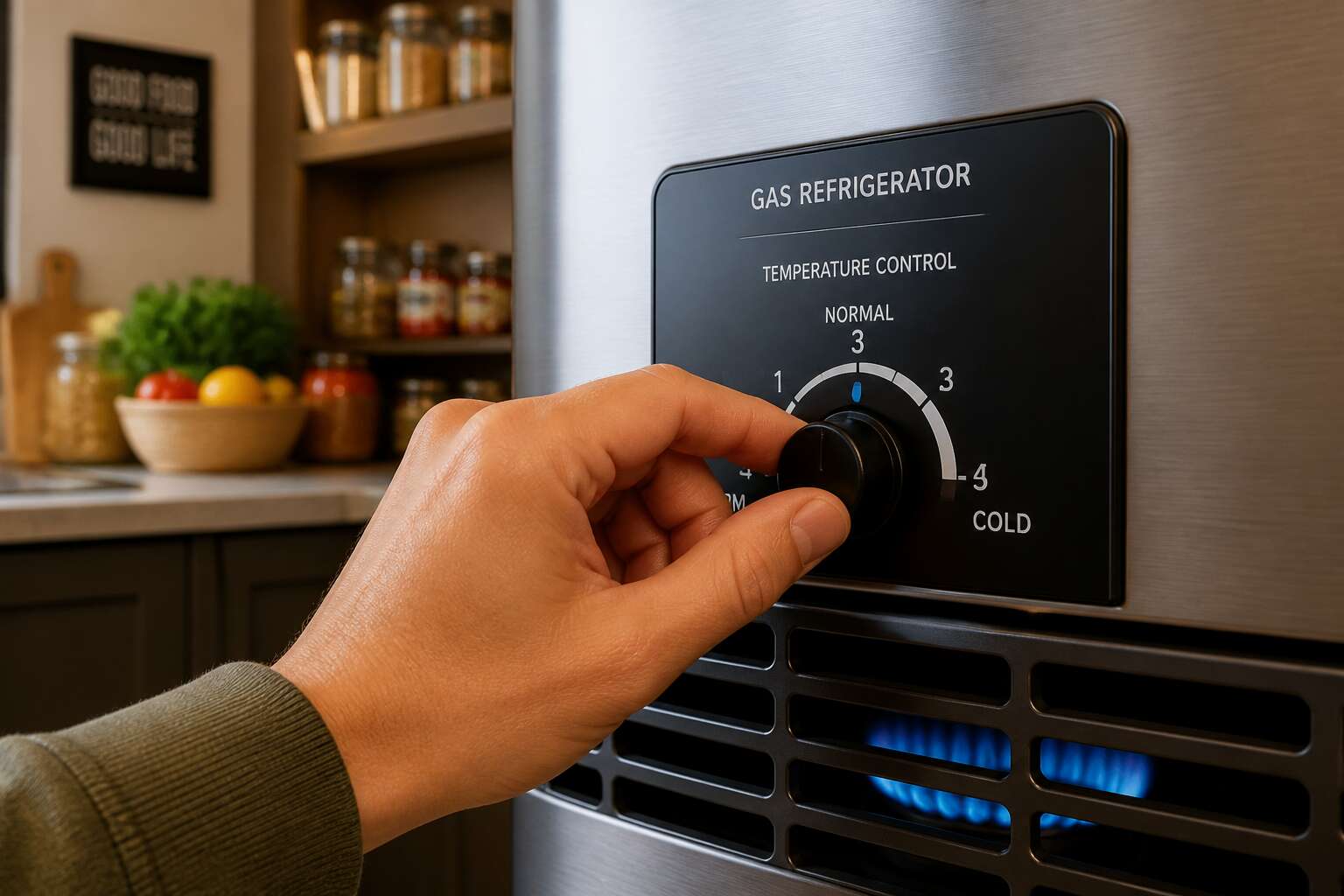
Statistically, most gas fridge temperature issues are not mechanical failures but settings that have gone rogue. Your control panel is usually tucked away inside the fridge near the ceiling, or in the upper fridge compartment rather than behind the crisper drawer. Getting to it is half the battle.
You will typically find a dial with numbers. On some models, the dial might be labelled with terms like “Off”, “Cold”, and “Coldest”. My own fridge had a dial that seemed to mock me by doing absolutely nothing for a day, then freezing my lettuce solid. Do not trust the dial’s position. Trust the thermometer you should place in the centre.
Here is how the dial usually breaks down:
1. A setting of zero on a gas fridge generally means off. This is the opposite of your stove.
2. The midpoint is usually the “correct” setting. Start here and give it a 24 hour grace period.
3. The highest number on the dial typically indicates maximum cooling, which is often too cold for regular use.
Remember that slow and steady wins this race. Turning that knob aggressively will just lead to a block of ice. If you need a colder temperature quickly, adjust it halfway to the next number and wait. The gas fridge temperature will stabilise, but it takes its sweet time. Just be sure to check that the “busy” setting is not selected if you want to avoid a mini ice age in your milk carton.
Step-by-Step Adjustment Process
Half the battle with a gas fridge temperature that behaves like a stubborn mule is the adjustment phase. Set the dial to the midpoint and then walk away. Seriously. Go make a cup of rooibos. The unit needs a full 24 hours to find its equilibrium, and your hovering will not speed up the process.
Once you have given it that grace period, check your thermometer. If the reading is off by a degree or two, make a small move. The dial operates on a simple principle for most units:
1. Turn the dial a single number.
2. Wait another 24 hours.
3. Monitor the thermometer in the centre of the shelf.
4. Repeat only if the temperature has not shifted.
You are managing a slow chemical reaction, not a smartphone app. A frantic twist of the knob will not instantly drop the temperature. It will just invite a layer of frost to form on your weekend braai meat. The gas fridge temperature adjusts through a cycle of absorption and pressure changes, so patience is the only tool that works here. Give it a full day, then check the milk. If it is still cold, but not slushy, you have nailed it. If you have to scrape ice off your lettuce, you went too far. Trust the process and the thermometer, not the dial’s promises.
Using a Thermometer for Accurate Readings
The thermometer is the only honest instrument in your kitchen. A gas fridge temperature that appears stable on the dial can drift silently, and your hand will not feel the difference until the butter hardens. Place a reliable thermometer on the centre shelf, away from the walls and the door. Let it sit for six hours before you trust its verdict.
Check the reading at the same time each day. The interior responds to ambient heat, so a morning reading will differ from an evening one. Use this ritual:
- Read the thermometer before any door opens.
- Record the number in a small notebook.
- Compare the trend, not a single moment.
That trend reveals whether the gas fridge temperature aligns with your needs. The dial is a suggestion. The thermometer is the truth.
Adjusting for Altitude and Ambient Conditions
Altitude shifts how a gas fridge temperature behaves. In Johannesburg’s thin air, the burner needs a higher gas pressure to maintain the same cooling. A technician can adjust the regulator to compensate. Coastal humidity in Durban requires checking the door seals more often, as moisture can freeze at the gasket.
Ambient heat changes the load. When the thermometer outside reads 35°C, the cooling unit cycles longer. Ensure the condenser coil has 50 millimetres of clearance on all sides.
- Measure the flame height monthly
- Adjust the air shutter for a blue flame
These tweaks keep the interior stable across South Africa’s varied climates.
Dealing with Thermostat Calibration Issues
Thermostat calibration can cause confusion. The gas fridge temperature may read perfectly at the dial, yet the actual interior disagrees. This discrepancy often stems from a sensor bulb that has slipped its clip or an accumulation of frost around the evaporator.
Common signs of misalignment:
- Milk freezing while butter softens
- The burner cycling on and off too frequently
- A dramatic temperature swing after a brief door opening
The calibration screw near the thermostat shaft offers a small correction range. Turning it clockwise lowers the temperature; counterclockwise raises it. The gas fridge temperature adjusts gradually, so patience matters. For coastal homes, a moisture-laden gasket can mimic calibration problems, so inspect that seal first.
Troubleshooting Temperature Problems
Not Cooling Enough – Common Causes and Fixes
If your fridge is behaving more like a lukewarm cupboard than a cold box, the culprit usually hides in plain sight. A gas fridge temperature creeping upward often points to airflow, gas pressure, or door seals.
The most common offenders include:
– Blocked ventilation grilles behind the unit.
– A worn door gasket letting cold air escape.
– Low gas pressure or a partially blocked burner nozzle.
Cleaning the condenser coils and sweeping dust from the flue restores proper heat exchange. A match test along the door gasket reveals air leaks instantly. In coastal South Africa’s humid conditions, corrosion in the gas line can also throttle cooling. Address these issues before blaming the fridge’s soul.
Overcooling and Freezing Issues
Some fridges turn into arctic caverns, freezing lettuce into brittle shards and turning milk into a solid block. The irony is that a gas fridge temperature plunging too low often stems from the same mechanical heart as its lethargic counterpart, yet the symptoms feel entirely different. The root cause is frequently a thermostat sensor that has drifted out of calibration or a faulty gas valve that refuses to close fully.
Common culprits include:
– A misaligned thermostat capillary tube touching the evaporator plate.
– A worn-out thermocouple failing to modulate the flame.
– An incorrect gas pressure setting that makes the burner roar too high.
This excess flame produces a cooling cycle that never pauses. You might notice ice building on the back wall or the fridge running through its gas supply faster than usual. The control knob may sit in its proper position, yet the fridge ignores your intent. Adjusting that knob sometimes fails because the valve itself has become sticky or scored. In coastal areas, salt air accelerates wear on these brass components, and a simple cleaning might restore the delicate balance. When overcooling persists, the internal pressure can cause frost to form silently behind the panels, which is why you should periodically check the thermostat and the flame colour. A steady blue flame suggests healthy combustion, while a yellow flicker signals trouble. This act of observation, checking the settings and the flame together, serves as the most direct window into the appliance’s mood. The gas fridge temperature responds to every nuance of that flame, and mastering that relationship is an ongoing dance, not a one-time fix. Always confirm you have adequate ventilation when testing these components, and remember that gas leaks are a separate concern entirely.
Uneven Temperature Distribution Inside the Fridge
Uneven temperature distribution inside a gas fridge temperature problem often reveals itself through a single spoiled jar of milk while the vegetables remain crisp. The evaporator plate cools, but cold air does not reach every shelf equally. Many owners block those currents with crowded shelves or containers pressed against the back wall.
The warmest zone sits near the door, where seals weaken and let outside air wander in. The coldest zone hugs the evaporator. Between them, a gradient exists that no thermostat reading can capture.
- High shelves interrupt the descent of cold air.
- An overpacked refrigerator blocks airflow between compartments.
- Damaged door gaskets allow warm air to seep in.
A gas fridge temperature reading at one point cannot represent the whole cabinet. I have seen fridges where the top shelf sits warm while the bottom drawer freezes! Every item placed inside changes the airflow.
Responding to Sudden Weather Changes
A sudden weather front can ambush a gas fridge temperature with surprising force, even when the unit sits safely indoors. The interior of a home absorbs ambient shifts slowly, yet the cooling system reacts to every change in external pressure and humidity. A cold snap tightens the refrigerant cycle, often pulling the cabinet toward frost, while a heatwave makes every opening of the door a costly trade. The thermostat reads only the air at its sensor, and that reading lags behind the true condition of your stored goods.
The safest response is to resist the urge to fiddle with the dial every time the sky changes. Instead, observe the trend over a full day. A single hot afternoon is not a reason to crank the setting lower; the cool evening will restore balance. However, a sustained heatwave demands a proactive approach, so adjust the gas fridge temperature before the interior climbs past the danger zone.
– Storm cooling can plunge the evaporator temperature quickly, risking frozen lettuce.
– Heatwave conditions raise the ambient baseline, forcing the burner to run longer.
– Humidity affects frost buildup, which in turn alters the unit’s efficiency.
Many owners in the Karoo or on the Highveld notice these swings more acutely, as their climate delivers both extremes in a single week. The thermal mass of your food acts as a buffer, so a full fridge weathers the storm better than a sparse one. The real enemy is a rapid change paired with frequent door openings. Monitor the thermometer for two days before committing to a new setting, and remember that consistency protects spoilage more than any single adjustment. A gas fridge temperature that matches the season, not the moment, keeps your provisions safe through any atmospheric tantrum. I have watched a Cape winter front drop the cabinet five degrees in one night, and only a quick dial correction saved the dairy.
When to Call a Professional Technician
Sometimes a gas fridge temperature misbehaves despite every dial twist and thermometer check. You have cleaned the flue, checked the door seal, and repositioned the unit. The cabinet still drifts beyond acceptable bounds. That is when you stop guessing. A certified technician owns the manometer, the combustion analyzer, and the liability insurance you lack. Before you dismantle anything, consider these warning signs:
- Yellow or flickering flame instead of a steady blue cone
- Odour of ammonia or gas near the burner compartment
- Rapid icing that returns within hours after defrosting
These symptoms point to blocked jets, failing thermocouples, or pressure regulator faults. Each requires precise calibration and gas-safe handling. For an issue that persists beyond three consecutive days, call a pro. The call costs money, but the alternative is spoiled provisions or a fire risk.
Maintaining Performance and Efficiency
Regular Maintenance Tasks for Consistent Cooling
Keeping your gas fridge temperature stable requires more than just adjusting dials. I have learned that a few minutes of maintenance each month saves hours of frustration later. The condenser coils, often hidden behind the lower grille, collect dust and grease that insulate them from the air. A soft brush and a vacuum handle this job effectively.
Check the door seals for wear. A damaged gasket lets cold air escape, forcing the unit to work harder. Wipe the seals with soapy water and inspect for cracks. Also, verify the burner flame shows a crisp blue colour. A yellow flame indicates incomplete combustion, which directly affects gas fridge temperature control.
- Clean the flue and burner assembly each year
- Replace the thermocouple if corrosion appears
- Keep ventilation grilles free of obstructions
Proper Ventilation and Airflow Clearance
According to the South African Energy Efficiency agency, improper ventilation can reduce a cooling appliance’s efficiency by up to 15 percent. This hidden inefficiency directly sabotages your gas fridge temperature stability while forcing the unit to cycle more frequently. The space behind and above the cabinet is not mere decoration, it is the lifeline for heat dissipation. When airflow is restricted, the compressor faces prolonged runtimes and the internal thermometer climbs past safe thresholds.
The combustion process in a gas fridge releases heat into the surrounding environment. This release is by design, but it requires generous clearance to disperse effectively. Many installations tuck the unit into a snug cabinet cavity without considering the manufacturer’s spec sheet. A gap of 10 to 15 centimetres behind the appliance allows the warm air to rise away from the condenser. Without this space, the ambient temperature around the cabinet rises, which forces the cooling system to work harder to maintain the set point.
Adequate side clearance matters equally for performance. When air cannot circulate freely around the heat exchanger, the unit experiences an elevated head pressure. This condition reduces the system’s overall energy efficiency and accelerates wear on internal components. For South African homes, where ambient temperatures often soar in summer, the placement of the fridge becomes a critical factor in achieving reliable performance. Every degree of extra ambient heat translates to additional strain on the cooling mechanism.
– Inspect the rear grille monthly for dust accumulation
– Push the cabinet away from the wall by the recommended distance
– Remove any decorative panels that obstruct side vents
– Check for curtains or drapes that cling to the sides of the unit
The floor beneath the fridge also requires attention to airflow. Some models draw air from the bottom and exhaust it through the top. A solid plinth or a deep pile carpet can choke this draught entirely. Even a slight obstruction at the base can cause the condenser to overheat, which leads to erratic cooling or a complete shutdown. South African homes often feature heavy underfloor insulation, which can accidentally block these lower intake vents when flooring is installed flush against the appliance.
Altitude adds another layer of complexity to the airflow equation. At higher elevations, the air is less dense, which reduces its heat carrying capacity. This means the ventilation system must work harder to remove the same amount of thermal load. A unit in Johannesburg requires more open space around it than the identical unit in Cape Town. Consider the specific installation environment before finalising the position of the gas fridge. Proper clearance is not a luxury, it is a technical requirement for maintaining optimal gas fridge temperature control throughout the year.
Energy Efficiency Tips for Gas Fridges
The unseen struggle for a stable gas fridge temperature often lies in the energy the unit consumes, not just the cold it produces. A refrigerant circuit that is slightly undercharged, for example, forces the flame to burn longer and hotter, creating a cycle of waste that eventually destabilises the interior. In an off-grid South African home, this inefficiency can drain a gas bottle quicker than expected, particularly when the unit sits in direct afternoon sun.
One overlooked ritual is the complete defrost. Ice build-up acts as an insulator, forcing the cooling system to overwork. Similarly, a door gasket that has lost its seal leaks precious cold air into the kitchen. This silent leakage is the primary adversary of consistent gas fridge temperature control, demanding more fuel to compensate for a loss that should never occur.
Consider the placement of thermometers and the frequency of door openings, as these habits define the load.
– Keep the refrigerator condenser fins clean to promote heat exchange
– Avoid storing warm leftovers; let them cool to room temperature first
– Check that the door seals are magnetic and free of cracks
The ambient humidity of coastal regions like Durban also plays a dark role. Moisture in the air condenses on the evaporator, forming frost that hampers performance. Weatherproofing the surrounding cabinetry, and ensuring the fridge is level, prevents this moisture from pooling and causing erratic operation. Each of these measures works in tandem to reduce the strain on the machine, allowing the gas fridge temperature to remain a steady, reliable constant even as the seasons shift.
Using Smart Monitoring Tools and Thermometers
The average hand cannot perceive a three degree shift inside a refrigerator, yet that margin decides how long your milk lasts. Believing you know the gas fridge temperature by touch is a gamble we lose quietly.
Smart monitoring tools, including wireless thermometers that log readings over 24 hours, reveal patterns that escape our attention. They show the gas fridge temperature spiking at 7 pm when dinner is prepared, then settling in the early hours when the Highveld air cools. This data transforms guesswork into knowledge. Over weeks, subtle drift appears, warning of a failing thermocouple or a clogged burner orifice.
- Place the probe near the middle shelf, away from the evaporator plate
- Record readings at the same hour daily to establish a dependable baseline
These instruments do not fix the machine. I have watched good owners ignore them for years, then wonder why their butter softens! They expose the relationship between your habits and the appliance’s labour, one that remains invisible without their intervention.
Long-Term Storage Practices to Preserve Coolness
The interior of a gas fridge holds competing temperatures. A packed shelf traps warmth near the front while the evaporator plate runs cold behind it. The gas fridge temperature then swings wider than any dial suggests.
Long term performance improves when you leave channels for air to move. Store dense goods like watermelons or jars of amasi toward the bottom, where cold air pools. Let freshly cooked stews cool on the counter before they enter; a steaming potload rewrites the thermal balance for hours.
Practices that preserve coolness:
- Group similar items so the door opens fewer times per meal
- Rotate stock so older goods live at the front, never buried
- Keep the storage area below half full where possible
Every opened door drains the cold. Over months, these habits determine whether your gas fridge temperature stays dependable or drifts into the danger zone.
Advanced Considerations for Off-Grid Living
Temperature Management During Power Outages
Load shedding tests every household’s patience, but for off-grid residents, the real challenge is keeping the gas fridge temperature steady when the grid goes dark. A gas fridge works without electricity, yet its performance depends on how you manage the environment. During an outage, the kitchen becomes a gathering point, meaning more door openings and warm air slipping inside.
I stock the fridge with dense items, such as water bottles, to add thermal mass that buffers against rapid swings. Every door opening forces the cooling unit to work harder, directly affecting the gas fridge temperature. I plan retrieval sessions carefully, grabbing everything in one swift visit.
- Check the burner flame for a clean blue color
- Keep condenser coils free of dust
These habits prevent spoiled food. When power returns, the fridge skips the defrost recovery that electric models face, offering a clear advantage for off-grid living.
Using Propane Efficiently for Optimal Cooling
Propane efficiency is the quiet obsession of anyone living beyond Eskom’s reach. A single 9 kilogram cylinder can last a fortnight or four days, and the difference often comes down to small habits.
The gas fridge temperature relies on consistent gas pressure. Fluctuations in the regulator make the burner hunt, wasting fuel and creating uneven cooling. I check for a yellow-tipped flame, which signals incomplete combustion. That flame wastes propane and coats the heat exchanger with soot, reducing heat transfer.
Storing cylinders in direct sunlight is another common mistake. Heat builds pressure inside the tank, and the regulator compensates by sending extra gas to the burner. The gas fridge temperature drops, but the gas bill climbs.
Propane burns cleanest when the burner assembly stays dust-free and the air shutter is set correctly for your altitude.
Safe Operation in Cold Climates and Winterization
The National Energy Regulator may promise grid stability, yet the quiet hum of an absorption fridge is what truly separates the prepared from the hopeful. In the Karoo winter, the cold becomes a curious adversary. The very air that should preserve your perishables works against the chemical reaction inside the cooling unit. A gas fridge temperature set in summer will drift when ambient temps plummet below freezing, because the cooling fluid loses viscosity and the flame struggles to maintain the necessary heat differential.
The commonsense solution, placing the unit in an unheated garage, introduces a hidden danger. Propane does not vaporize efficiently at very low temperatures. The regulator may freeze, causing the burners to sputter or fail altogether. This is where safe operation in cold climates demands a deliberate design choice. The unit must be installed in a location that remains above five degrees Celsius, yet still offers the required ventilation. A covered but unsealed veranda, shielded from the wind, often serves better than a frigid outbuilding. If the fridge lives inside, ensure the room is not pressurized by a space heater, which can starve the burner of oxygen.
Winterization for an off-grid fridge involves more than just draining water lines. Consider the propane system itself. Moisture in the gas line can freeze and create a blockage at the orifice.
– Always secure the cylinder valve cap when not in use to prevent ice ingress.
– Clear any snow or debris from the fridge’s combustion vent, as a blocked flue can cause backdrafting.
– Inspect the door seals for hardening, as cold weather makes gaskets brittle and warps the seal, letting cold air in and warm air out.
The psychological comfort of a cold beer on a winter evening masks the mechanical diligence required. The gas fridge temperature must be policed daily, not because the dial moves, but because the silence of a perfectly balanced flame is the only true indicator of efficiency. A blue flame in winter is not just a sign of good combustion; it is a testament to your control over the elements, ensuring the propane pressure remains steady enough to keep the internal temperature at a safe three degrees while the world outside freezes solid.
Integrating with Renewable Energy Systems
The irony of off-grid living is that the solar panels never power the refrigerator. A gas fridge temperature is governed by flame and ammonia, so the lithium battery bank has no say in the matter. The refrigerator remains the last hydrocarbon appliance in an otherwise electrified homestead.
The practical implications are strange. You can run a coffee machine from stored sunlight, but the gas fridge temperature still depends on a cylinder refilled in town. This separation invites a hybrid approach. Some Karoo residents run a DC compressor fridge on solar during the day and switch to gas at night, though the switching adds wear to seals and igniters.
- The cylinder stockpile must balance flame consumption against solar battery autonomy.
- A propane leak detector linked to the solar monitor gives unified oversight.
The renewable system extends only as far as the inverter allows. The gas flame answers to no photovoltaic cell.
Remote Monitoring Solutions for Temperature Alerts
Off-grid Karoo homesteads are often kilometres from the nearest cell tower, which makes the idea of a remote temperature alert feel almost absurd. Yet a simple LoRaWAN sensor placed inside the refrigerator cabinet can transmit a gas fridge temperature reading across the farmyard to a base station linked to the solar monitor. No Wi-Fi required, no monthly data bill, and no signal bar to watch.
The value becomes plain during a three day berg wind, when the flame blows out and the cabinet creeps past fifteen degrees. A silent failure can ruin a week of provisions before I open the door. With a monitoring system, the alert reaches my phone while I am still in the landy returning from town.
The available units differ in three practical respects:
- Some transmit on open LoRa bands, others ride the cellular network.
- Some probes are wired, others are wireless.
- Some gateways are solar powered, others draw from the inverter.
These systems do not adjust the gas fridge temperature, but they remove the guesswork from living with a flame you cannot see.


0 Comments